

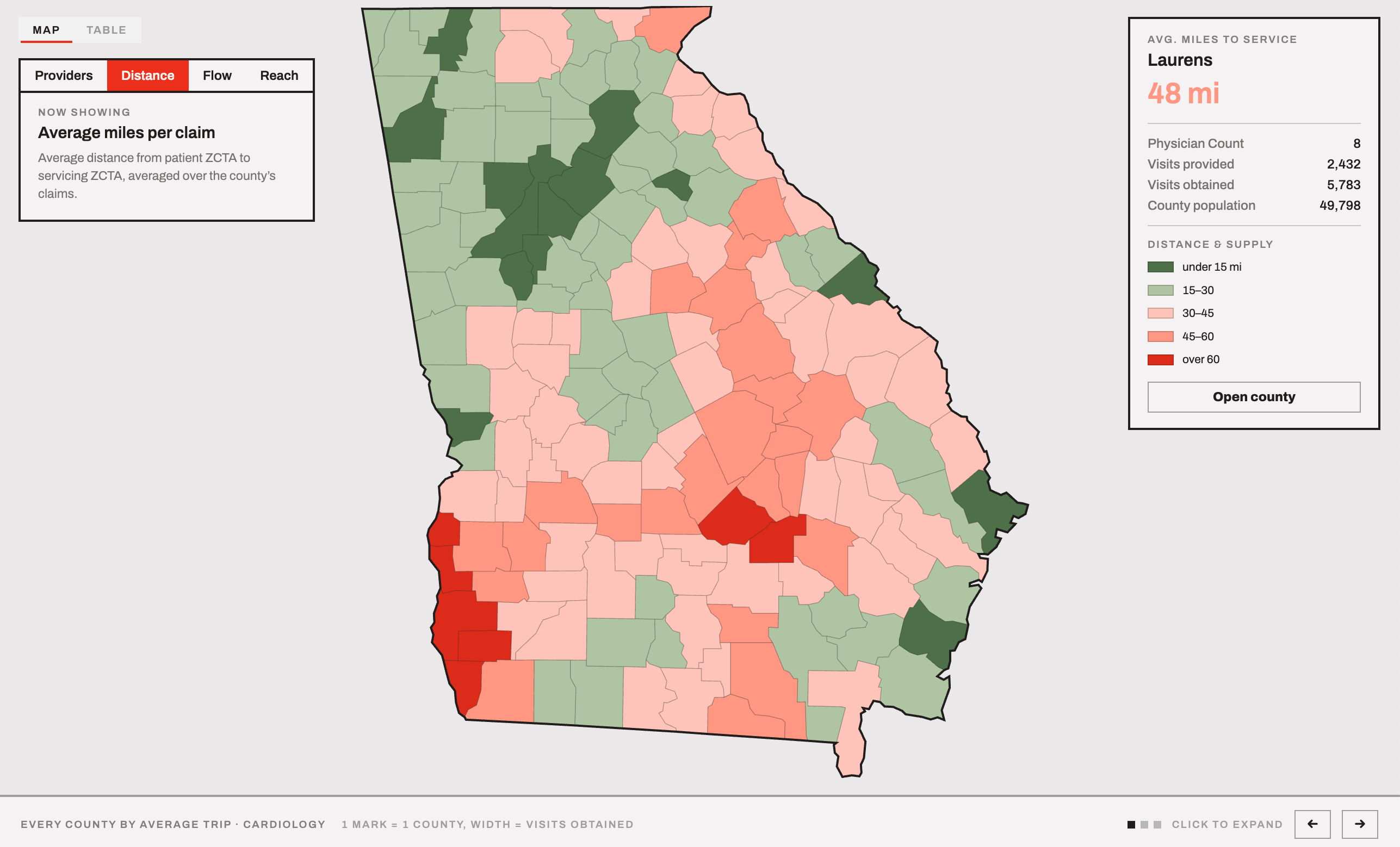
Georgians living in rural areas are more likely than the state’s city dwellers to suffer from cardiovascular disease and to die from preventable causes.
Policymakers, health system executives, community leaders and others working to address this challenge now have help from Rural Evaluation and Analytics for Community Health (REACH GA), an advanced decision-support platform that offers a comprehensive view of healthcare use in rural Georgia. In addition to updated information on rural health issues, the platform provides computer-based tools to guide allocation of healthcare resources and explore the potential impact of changes to rural health services.
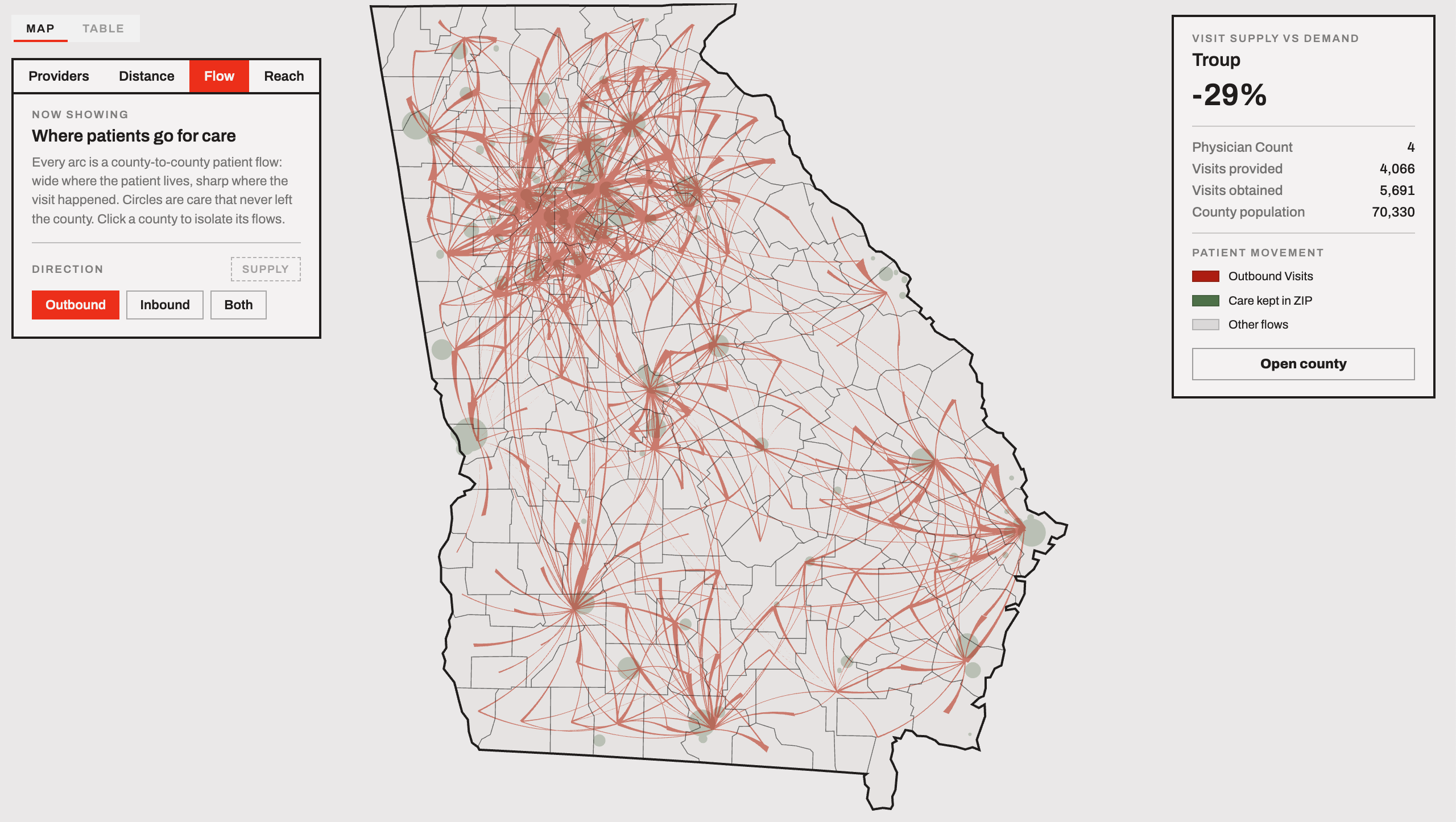
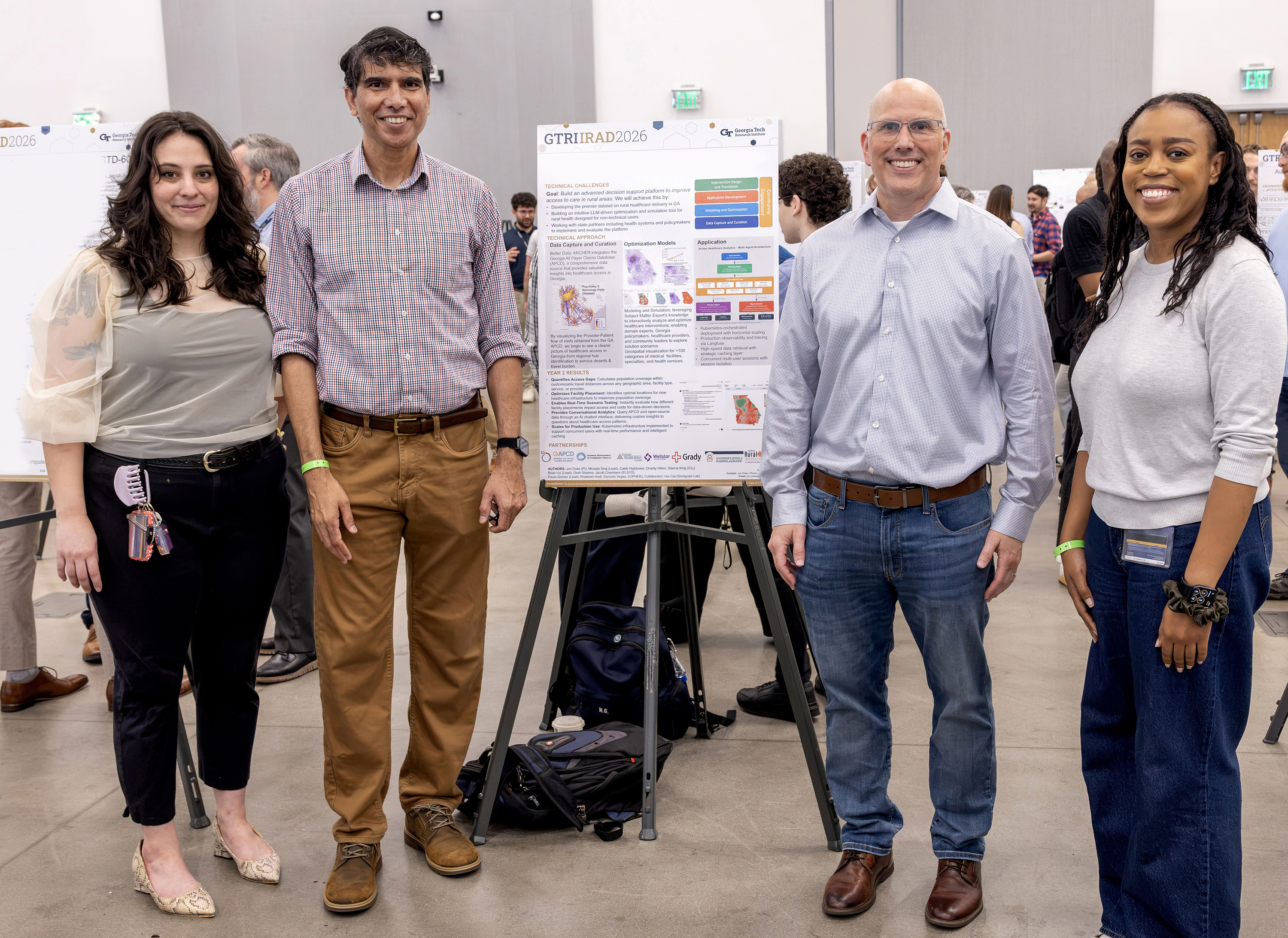
“The REACH GA platform provides up-to-date, actionable information to help leaders understand the big picture of healthcare in rural Georgia,” said Jon Duke, M.D., a principal research scientist in the Georgia Tech Research Institute (GTRI) and the project’s principal investigator. “Beyond more accurate data, the platform uses artificial intelligence (AI) and other computer-driven tools to support improved decision-making.”
Of Georgia’s 159 counties, 126 are considered rural. Approximately 24 percent of the state’s 11.3 million residents live in these rural areas.
REACH GA was developed by GTRI researchers in collaboration with healthcare providers, state leadership, public health agencies, and the Georgia Rural Health Innovation Center. GTRI researchers will use REACH GA to support their work for the Georgia Rural Enhancement and Transformation of Health Program (GREAT Health) a major new initiative that is part of the national Rural Health Transformation Program (RHTP).
Over the next five years, GREAT Health – which is managed by the Georgia Department of Community Health – will invest in new initiatives aimed at improving rural health outcomes in the state. RHTP is administered by the U.S. Centers for Medicare and Medicaid Services (CMS).
First-of-Its-Kind Comprehensive Data
REACH GA uses data gathered by the Georgia All-Payer Claims Database (APCD), which contains information on millions of insurance claims from both public and private providers in the state. The APCD data supplements information from sources such as professional licensing records.
Licensing records and other traditional sources of healthcare information show what types of healthcare providers are working in Georgia, but not necessarily where they serve patients. Data from the new platform can help show where providers actually spend their time.
Since 2001, more than 35 percent of rural hospital capacity has been lost to closures and other causes. This has increased patient travel time to access emergency services by as much as eight-fold in some rural communities. Other specialty services such as pediatrics, internal medicine, and obstetrics often fall short of rural area needs, creating a “care desert.”
“In Georgia, there are counties where the average distance patients travel for care may be 60 or 70 miles,” Duke said. “That means a full day off from work for many people and can be a significant barrier to treatment.”
Understanding the Impacts of Proposed Solutions
While adding a new specialty clinic may seem like the solution to a care desert, a new facility in one community may take away patients from similar clinics in nearby communities, potentially harming the sustainability of both the new facility and existing one.
“You really have to be strategic in adding resources to be sure you are complementing the ecosystem and not complicating sustainability models for different facilities,” Duke explained. “It’s a really interesting and challenging problem that our healthcare stakeholders must deal with.”
REACH GA uses its modeling and simulation tools, along with AI programs, to help stakeholders understand those issues — and their potentially unexpected impacts. Those tools set the new platform apart from earlier healthcare data systems.
“A lot of states have looked at rural health through dashboards and other tools, but with REACH GA, we’ve taken it to a much higher level with modeling and analysis, doing location optimization, and financial modeling for services,” Duke said. “We also integrated AI and natural language components to make the information more accessible and usable by our stakeholders.”
Rural Health as a National Security Issue
Improving the health of rural citizens is not just a cost or compassionate issue. It’s also a matter of national security — one of GTRI’s top priorities.
Duke notes that Southern states supply a disproportionate share of recruits for the U.S. armed services. But increasing numbers of those would-be warfighters cannot meet physical fitness tests, or they suffer from chronic diseases such as diabetes.
“REACH GA helps us address national security needs as it improves healthcare in Georgia’s rural areas,” he added.
Duke expects the program will continue to expand to help providers, the state, and community leaders work together to improve the health of rural Georgians. “REACH GA is now on the launching pad for some really exciting work that will mark a very significant change in how care is delivered in Georgia’s rural areas,” Duke said.
The project is supported by GTRI’s Independent Research and Development program. Other researchers involved include Micaela Siraj, Caleb Hightower, Charity Hilton, Dianna King, Brian Liu, Desh Sharma, Jacob Chambers, Paula Gomez, Khatereh Hadi, and Gonzalo Vegas, all from GTRI, and Hui Cai from the SimTigrate Lab in Georgia Tech’s College of Design.
ABOUT GTRI: The Georgia Tech Research Institute (GTRI) is the nonprofit, applied research division of the Georgia Institute of Technology (Georgia Tech). Founded in 1934 as the Engineering Experiment Station, GTRI has grown to nearly 3,000 employees, supporting eight laboratories in over 20 locations around the country and performing more than $1 billion of problem-solving research annually for government and industry. GTRI's renowned researchers combine science, engineering, economics, policy, and technical expertise to solve complex problems for the U.S. federal government, state, and industry.
Writer: John Toon (john.toon@gtri.gatech.edu)
GTRI Communications
Georgia Tech Research Institute
Atlanta, Georgia USA

Related News


