The Georgia Tech Quantum Applications Research Center will connect expertise from across Georgia Tech and GTRI to advance quantum research, collaboration, and support emerging technologies.
The Institute for Matter and Systems (IMS) at Georgia Tech, in collaboration with the Georgia Tech Research Institute (GTRI), has launched the Georgia Tech Quantum Applications Research Center (GT QuARC), a new interdisciplinary research center designed to bring together Georgia Tech’s quantum research community, expand strategic partnerships, and accelerate the development of quantum technologies and applications.
The center is co-directed by Martin Mourgial, Dunn Family Professor in the School of Physics, and Robert Wyllie, division chief of the Quantum System Division in the Cybersecurity, Information Protection, and Hardware Evaluation Research (CIPHER) lab at GTRI.
“Quantum technologies are rapidly moving from scientific theory toward practical application,” said Julia Kubanek, vice president of Interdisciplinary Research. “This center builds on Georgia Tech’s expertise to help lead that transition by connecting research with industry, government, and societal needs.”
Building on Georgia Tech’s strengths in atomic physics, materials science, engineering, computing, photonics, sensing, and advanced manufacturing, GT QuARC will serve as a hub for quantum research and collaboration across Georgia Tech and GTRI. The center will help bridge fundamental discovery and practical application, creating new opportunities in quantum technologies while strengthening Georgia Tech’s leadership in areas such as computing, sensing, communications, and national security.
Quantum technologies use the principles of quantum mechanics to perform tasks that are difficult or impossible with conventional technologies. As federal agencies and industry partners continue to increase investments in quantum research and development, Georgia Tech is positioned to contribute to advances in quantum materials, devices, systems, algorithms, and applications.
“Quantum breakthroughs happen at the intersection of disciplines,” said Wyllie. “By connecting the researchers and resources across Georgia Tech and GTRI, we’re building a stronger foundation for quantum innovation.”
GT QuARC will strengthen these efforts by providing a unified identity for Georgia Tech’s quantum community and creating new opportunities for interdisciplinary collaboration among researchers, students, industry partners, government agencies, and national laboratories.
“One goal for the center is to identify meaningful applications for emerging quantum technologies,” said Mourigal. “Another is to build connections among researchers, industry, and government. Those conversations are essential to discovering where quantum technologies can have the greatest impact. For that to happen, we must coordinate and optimize efforts across campus.”
“A core part of IMS’s mission is creating opportunities that enable breakthrough discoveries and accelerate emerging areas of research," said Eric Vogel, executive director of IMS. “GT QuARC, provides a framework for bringing together Georgia Tech’s quantum expertise and building the partnerships needed to advance both scientific discovery and real-world impact.”
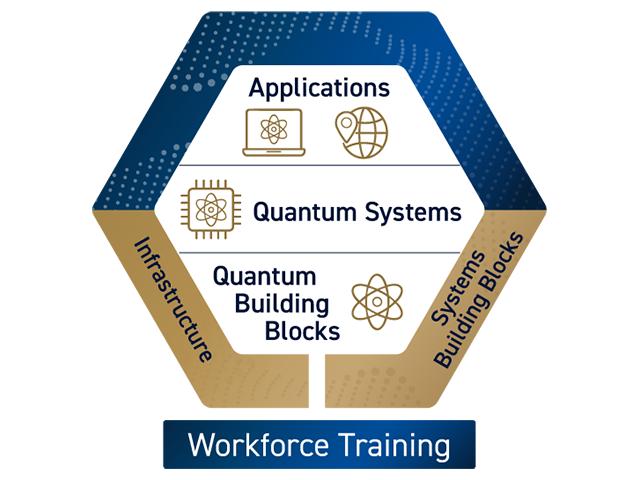
The center will initially focus on three research thrusts:
Quantum Building Blocks and Enabling Technologies will advance the materials, devices, fabrication methods, control technologies, and characterization capabilities needed to create and manipulate quantum states.
Quantum Systems and Manufacturing Testbeds will integrate the building blocks into scalable quantum sensing, computing, communication, and simulation platforms, supported by shared research infrastructure and manufacturing capabilities.
Quantum Computing, Algorithms, and Applications will develop quantum and hybrid quantum-classical approaches to challenges in scientific discovery, industry, national security, and other areas of societal importance.
These efforts will help move quantum technologies from the laboratory toward practical use while creating new opportunities for collaboration across disciplines.
In addition to advancing research, GT QuARC will support education and workforce development by expanding hands-on learning opportunities, strengthening industry engagement, and connecting students with emerging careers in quantum science and engineering.
The center will also help Georgia Tech pursue strategic investments in quantum infrastructure, including advanced characterization capabilities, micro- and nanofabrication resources, sensing platforms, and access to leading quantum computing systems.
By bringing together expertise from across Georgia Tech’s colleges, research centers, and GTRI, GT QuARC will help position the Institute as a leader in translating quantum discoveries into technologies that address national priorities and societal challenges.
To learn more about Georgia Tech’s quantum ecosystem, visit quantum.gatech.edu.

Related News