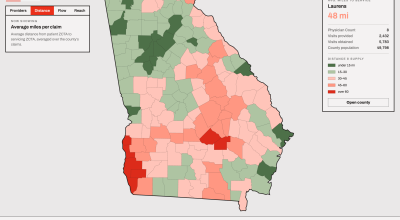
Georgia residents now have a new way to compare the estimated costs paid for a large variety of health care services in the state, thanks to a searchable “shop for care” resource launched as part of the Georgia All-Payer Claims Database (GA APCD).
The Georgia APCD Cost Comparison Tool (apcd.georgia.gov/cost-comparison-tool) contains information on more than 200 different medical procedures ranging from cardiac stress tests and childbirth to knee replacement and colonoscopies. The resource provides information on the median cost paid for the procedures statewide, along with information on what individual medical facilities and professional providers have been paid for each type of procedure.

For each procedure, the tool identifies medical facility providers nearest to the consumer and includes facility ratings collected by the Centers for Medicare & Medicaid Services (CMS). For each facility providing a specific service, the comparison data includes the median cost for the procedure and the range of costs that were paid. Costs can be filtered by payer category, including commercial, Medicare, and Medicaid. While that data is understandably incomplete and includes caveats, developers of the new service say it provides a much-needed resource for Georgians facing a decision on a costly medical procedure.
“In health care, there are a lot of factors that can drive cost and it’s not always a straightforward equation, so it’s worth doing the research,” said Dr. Jon Duke, an M.D. and principal research scientist in the Georgia Tech Research Institute’s (GTRI) Health Emerging and Advanced Technologies Division, which administers the APCD for the state of Georgia. “This is really just one part of health care decision-making, and it will help patients be more proactive advocates for themselves when considering potential options for care.”
Georgians making choices about upcoming medical procedures should talk with their medical providers as well as log into their insurer’s website to get more plan-specific cost information, he said. For Medicare and Medicaid patients, costs may already be established through agencies administering those services, though patients often have choices concerning providers.

According to the new tool, the median statewide commercial facility cost for a common surgery – knee replacement – is $17,199, with the median professional provider adding another $2,239 to that. Across the state, the cost of that procedure ranges on the low end from $6,833 for the facility and $590 for the provider to $22,963 and $2,673 respectively. Other procedures also have significant cost variability, for instance, with cardiac stress tests ranging from $231to $2,094, colonoscopies from $377 to $2,845 and leg X-rays from $46 to $348.
Duke says there are a lot of reasons for the cost variations, including local competition, whether the facility is associated with a large hospital or research facility, whether the hospital attracts patients with more complex conditions, and how the procedures themselves are coded. Rapid advances in technology, such as new imaging equipment, may also affect patient costs.
The Cost Comparison Tool is based on data from the more than 1.5 billion health insurance claims now included in the Georgia APCD database. Updated regularly, the GA APCD (apcd.georgia.gov/) includes information on health insurance claims submitted by more than two dozen major providers of health insurance.
“This is meant to be a consumer tool where people can look at certain procedures that they might be undergoing and compare the median costs that are reported to the APCD for that procedure,” said Charity Hilton, a GTRI research scientist also involved in the project. “Patients can see what the costs might be compared to other facilities in their area. The data behind the Cost Comparison Tool is really quite complex and it has taken quite a bit of work to make it useful to consumers.”
The costs listed include the total billed to insurance and to the patient. Additional services may be required to support the listed procedure.
While the APCD includes only information from health insurance claims, it is the largest and most complete data source on health care costs for Georgia citizens. Beyond its value to consumers, that information is expected to have many other applications.
“One of the key reasons that we need the APCD is to support decisions that have to be made by employers, health systems, regulators, and legislators who might otherwise have to depend on a much more limited set of data,” said Duke. “We can provide quality data for those really challenging decisions.”
The APCD was established by the Georgia General Assembly (O.C.G.A. 31-53-40) by Senate Bill 482 in 2020 to address growing concerns over the cost, quality, and access to health care across the state. The Georgia Office of Health Strategy and Coordination (OHSC) is responsible for creating and implementing the APCD, and GTRI serves as the APCD's administrator.
Information in the database comes from health insurance organizations that are required by law to provide the information. Many other states have similar APCDs that also provide similar sources of information on healthcare costs, disease prevalence, disparities, and how services are utilized. The data included in the Cost Comparison Tool are from 2023 and 2024 and do not include all payers or all health care facilities in the state.
Development of the APCD has put Georgia among the more than two dozen U.S. states that are able to make critical health care decisions based on information about the specific needs of their citizens, Duke said. “The Georgia APCD has moved Georgia into the ranks of states that have a deeper understanding of their population’s health, healthcare costs and utilization, and opportunities for improvement,” he added.
Several other states, including Colorado, Indiana and Maine, have also provided consumers access to comparative cost data through their APCDs, Hilton noted.
Writer: John Toon (john.toon@gtri.gatech.edu)
GTRI Communications
Georgia Tech Research Institute
Atlanta, Georgia USA
About the Georgia Tech Research Institute (GTRI)
The Georgia Tech Research Institute (GTRI) is the nonprofit, applied research division of the Georgia Institute of Technology (Georgia Tech). Founded in 1934 as the Engineering Experiment Station, GTRI has grown to more than 3,000 employees, supporting eight laboratories in over 20 locations around the country and performing more than $919 million of problem-solving research annually for government and industry. GTRI's renowned researchers combine science, engineering, economics, policy, and technical expertise to solve complex problems for the U.S. federal government, state, and industry.

Related News