


 Gary Ashworth, who most recently served as Acting Secretary of the Air Force, will join the Georgia Tech Research Institute (GTRI) as its Director of Washington Operations effective July 1.
In this position, Ashworth will provide leadership, strategic insights, and conduct key engagements to support and advance GTRI’s strategic efforts. He will work closely with GTRI leadership to enhance strategic relationships with federal agencies in the greater Washington, D.C. metro area.
“We are very pleased to have Gary Ashworth join GTRI in this crucial role leading operations in our nation’s capital,” said Tommer Ender, Interim Director of GTRI and Senior Vice President for the Georgia Institute of Technology (Georgia Tech). “Gary’s extensive experience with Department of Defense acquisition, sustainment, research, development, and engineering will help us fulfill GTRI’s mission of supporting national security, improving the human condition, serving the state of Georgia, and educating future technology leaders.”
Prior to his service as Acting Secretary, Ashworth served as Assistant Secretary of Defense for Acquisition, where he advised the Under Secretary of Defense for Acquisition and Sustainment, the Deputy Secretary of Defense, and the Secretary of Defense on matters relating to the Department of Defense (DoD) Acquisition System, acquisition program management, and the development of strategic, space, intelligence, tactical warfare, command, control, communications, computers, intelligence, surveillance, reconnaissance (C4ISR), and business systems.
Additionally, he has served as the Principal Deputy Assistant Secretary of Defense for Acquisition and the Deputy Assistant Secretary of Defense (DASD) Strategic, Space, and Intelligence Portfolio Management (SSIPM). In these roles, he was responsible for acquisition shaping, analysis, and oversight of warfighter capability portfolios across the DoD associated with nuclear weapons systems; nuclear command, control, and communications (NC3); space; missile defense; and C4ISR domains.
Ashworth has been involved in all phases of DoD acquisition, sustainment, research, development, and engineering since joining the defense acquisition workforce in 1992. His prior OSD duties included Director, Space and Missile Defense and Nuclear Weapons Systems Acquisition Lead for the OUSD (A&S). He also served as a Major Defense Acquisition Program Support Team Lead for OUSD (Research and Engineering) where he provided systems engineering support to and led independent technical risk assessments on more than 60 major defense acquisition and information system programs in the nuclear weapon system, NC3, and C4ISR domains.
“Throughout the defense community, the Georgia Tech Research Institute has long been known as a foremost innovator in developing the problem-solving solutions and new technologies essential to our national security,” said Ashworth. “I am excited to join this dynamic organization and look forward to working with my new colleagues at GTRI to continue developing the solutions and technologies needed by our nation’s warfighters.”
Ashworth served in uniform in the Air Force for more than 20 years. His final USAF assignment was serving as a squadron commander of an acquisition squadron and program manager for several C4ISR programs. Operational assignments include serving as a nuclear war plan advisor and command and control exercise planner for U.S. Strategic Command, as well as a missile combat crew commander for a Minuteman Intercontinental Ballistic Missile weapon system.
Ashworth holds a B.S. in electrical engineering from Lehigh University, an M.S. in electrical engineering from South Dakota School of Mines and Technology, and a Master’s Degree in military operational art and science from Air University. He most recently obtained an M.S. in cybersecurity from Johns Hopkins University.
GTRI’s Washington D.C. Field Office is located in the Rossyln City Center in Arlington, Virginia, and is among 20 locations around the United States where GTRI serves the federal government, state of Georgia, and industry.
###
Media Contact: gtri.media@gtri.gatech.edu
About the Georgia Tech Research Institute:
The Georgia Tech Research Institute (GTRI) is the nonprofit, applied research division of the Georgia Institute of Technology (Georgia Tech). Founded in 1934 as the Engineering Experiment Station, GTRI has grown to more than 3,000 employees, supporting eight laboratories in over 20 locations around the country and performing more than $919 million of problem-solving research annually for government and industry. GTRI's renowned researchers combine science, engineering, economics, policy, and technical expertise to solve complex problems for the U.S. federal government, state, and industry.

Related News

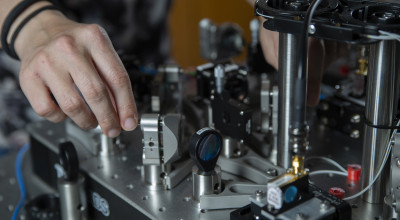
Trapped ions excited with a laser beam can be used to create entangled qubits in quantum information systems, but addressing several stationary pairs of ions in a trap requires multiple optical switches and complex controls.
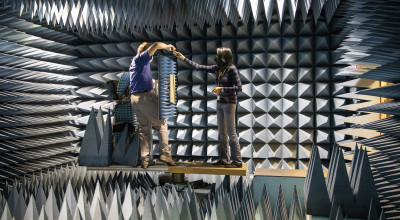
Digitally-reconfigurable modular hardware and software building blocks designed to work together are key components of GTRI’s Software-Defined Configurable RF Array (COBRA) initiative, which is intended to facilitate rapid development of low-cost phased-array radar systems for ground, airborne, spaceborne, electronic warfare, communication, and other applications.