


According to a recent National Defense Magazine article, the Pentagon is increasingly turning to the commercial sector to bolster its capabilities in this domain. GTRI’s expertise and ongoing research align with this strategic direction, positioning us as a key contributor to the nation’s defense initiatives.

David Zurn, chief of The Electronic Systems Laboratory's (ELSYS) Test Engineering Division (TENS) and Regents' Researcher, is featured in the article.
Zurn said defining electronic warfare in space is difficult because it is a “complex topic with many layers and many different modalities” that may involve jamming, lasers and GPS denial, to name a few. But for Zurn, it comes down to the links.
“Space electronic warfare involves defending and denying the link segment,” he said during the panel. “The link segment is that link between the ground terminal and the space vehicle. It is critical to space operation — and space electronic warfare, from my perspective, is the adversary trying to deny that link and us trying to defend that link, and vice versa.”
GTRI’s commitment to advancing electronic warfare capabilities is further exemplified by the technologies it is developing. Such efforts not only align with the Department of Defense’s objectives but also reinforce GTRI’s role as a leader in addressing complex challenges.
Zurn said the communication between the Space Force and commercial space is “pretty cool."
National Defence is the organ of the National Defense Industrial Association (NDIA). NDIA says it aims to drive strategic dialogue in national security by identifying key issues and leveraging the knowledge and experience of its military, government, industry, and academic members to overmatch capabilities to threats.
Writer: Christopher Weems
GTRI Communications
Georgia Tech Research Institute
Atlanta, Georgia
The Georgia Tech Research Institute (GTRI) is the nonprofit, applied research division of the Georgia Institute of Technology (Georgia Tech). Founded in 1934 as the Engineering Experiment Station, GTRI has grown to more than 2,900 employees, supporting eight laboratories in over 20 locations around the country and performing more than $940 million of problem-solving research annually for government and industry. GTRI's renowned researchers combine science, engineering, economics, policy, and technical expertise to solve complex problems for the U.S. federal government, state, and industry.

Related News

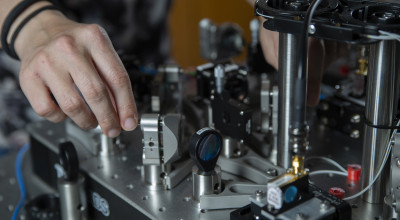
Trapped ions excited with a laser beam can be used to create entangled qubits in quantum information systems, but addressing several stationary pairs of ions in a trap requires multiple optical switches and complex controls.
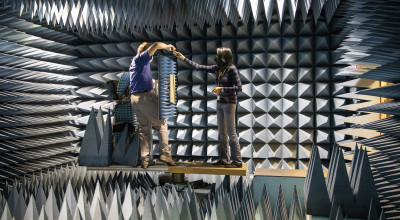
Digitally-reconfigurable modular hardware and software building blocks designed to work together are key components of GTRI’s Software-Defined Configurable RF Array (COBRA) initiative, which is intended to facilitate rapid development of low-cost phased-array radar systems for ground, airborne, spaceborne, electronic warfare, communication, and other applications.