


Developing a technology that works is a major milestone, but it is not the end of the story. What happens next can determine how far an innovation travels beyond the lab and who ultimately benefits from it.
The Georgia Tech Research Institute, or GTRI, is Georgia Tech’s applied research organization and a University-Affiliated Research Center. Its researchers develop technologies that address specific government and industry needs, including the federal government’s long-term national security priorities.
Some of those technologies may also have potential beyond the mission or research assignment for which they were originally developed. Through the Office of Commercialization, GTRI researchers can receive support protecting intellectual property, exploring additional applications, and identifying partners that can help move their work forward.
Working With Technology Licensing to Explore What Comes Next
Within the Office of Commercialization, the Office of Technology Licensing (OTL) works with GTRI researchers to identify and protect intellectual property, evaluate potential applications, and explore pathways for moving technologies into broader use.
For GTRI researchers, the opportunity may be the potential for a technology to serve another use beyond its original research assignment. A technology developed for one mission could help solve another problem, support a new industry application, or provide the foundation for a future product. Recognizing that potential early gives researchers and OTL more time to explore what else may be possible.
“It’s a true partnership where we bring the technology and mission context, and they bring the commercialization expertise and industry networks,” said Kenneth W. Allen, chief technology officer at GTRI.
Read more at Georgia Tech Research News Center

Related News
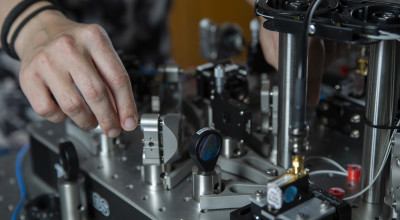
Trapped ions excited with a laser beam can be used to create entangled qubits in quantum information systems, but addressing several stationary pairs of ions in a trap requires multiple optical switches and complex controls.
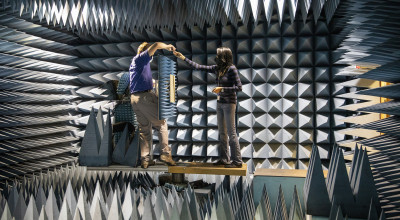
Digitally-reconfigurable modular hardware and software building blocks designed to work together are key components of GTRI’s Software-Defined Configurable RF Array (COBRA) initiative, which is intended to facilitate rapid development of low-cost phased-array radar systems for ground, airborne, spaceborne, electronic warfare, communication, and other applications.

A new and comprehensive database of healthcare claims paid in the state of Georgia will help identify disease trends, provide information for making public policy decisions, facilitate new research – and offer a way for consumers to determine the average cost of common procedures such as knee replacement or diagnostic testing such as MRIs.