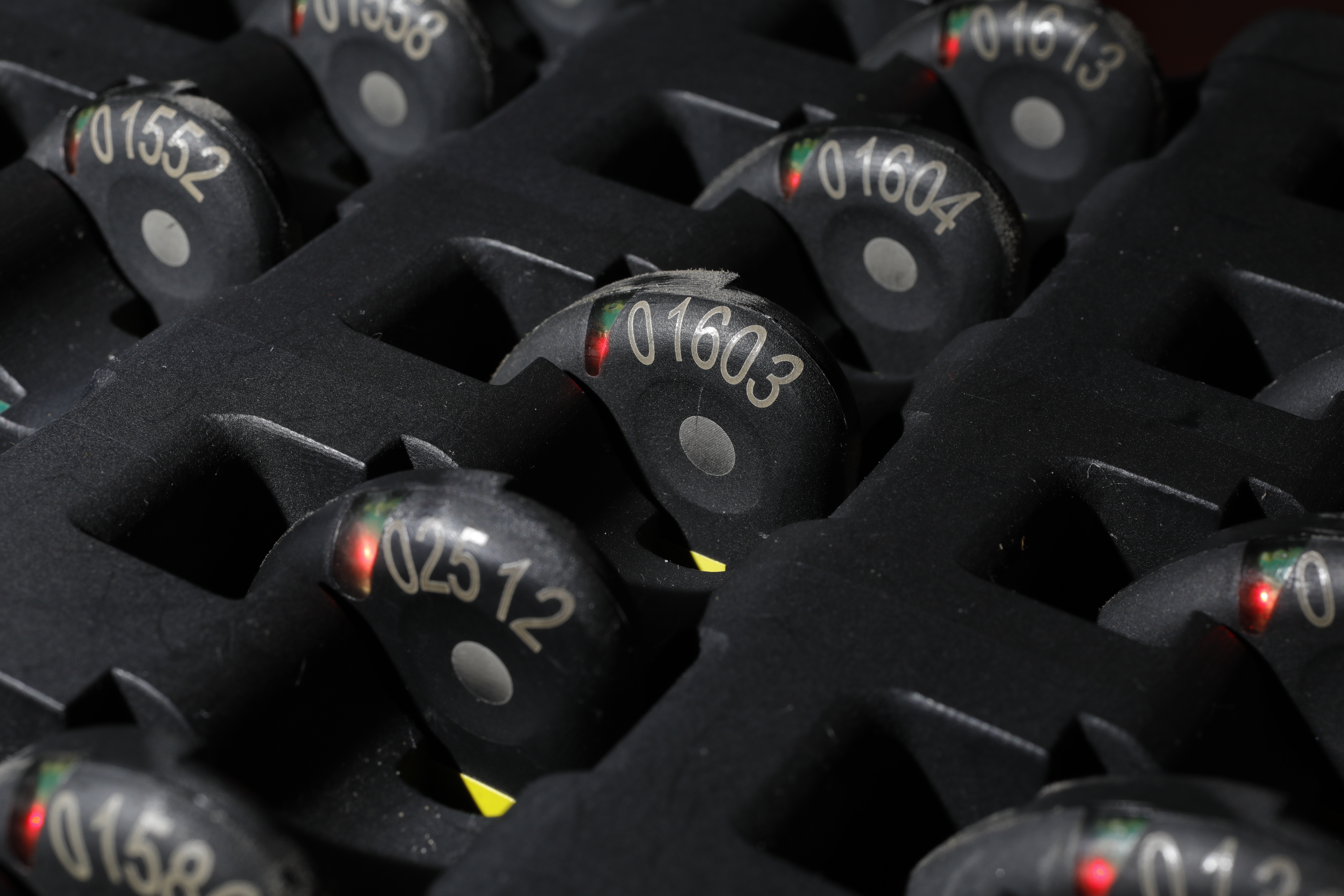
The Georgia Tech Research Institute (GTRI) recently earned a top industry award for its co-development of a technology designed to prevent heat injuries in soldiers.
The Heat Injury Prevention System (HIPS), a wearable sensor system that can monitor a person's heat injury risk, was honored with an “R&D 100” Award from R&D World, a leading publication for research scientists and engineers worldwide. Dubbed the “Oscars of Innovation,” the awards recognize the 100 most significant technologies transitioned to use or introduced into the marketplace in the past year.
HIPS resembles a standard chest-strap heart rate monitor and provides accurate, early warnings of heat stroke minutes before visible symptoms appear. It achieves this by collecting data from a sensor worn on the chest strap and employs algorithms for estimating body temperature, gait instability, and adaptive physiological strain index.
GTRI collaborated with the Massachusetts Institute of Technology's Lincoln Laboratory (MIT-LL), which developed the HIPS device, as well as the U.S. Army Medical Materiel Development Activity (USAMMDA), the U.S. Army Research Institute of Environmental Medicine (USARIEM), and Odic Inc., an engineering research and development company responsible for its manufacturing.
The affordability, accuracy, and user-acceptability of HIPS have led to its integration into operational environments for the military. GTRI developed a local network system that captures real-time data from the HIPS sensor and sends that data over a cellular connection to a cloud server. An individual's physiological state, including heat-injury prediction and geolocation, can then be monitored by a command and control center or with unit commanders and others who are within close proximity to the soldiers.
“We are honored to receive this recognition,” said Alessio Medda, a GTRI principal research engineer who is co-leading the project. “Our work on HIPS reflects GTRI’s mission to develop innovative solutions that have a real-world impact – namely, to save the lives of our warfighters who are defending our country.”
Dr. Medda is co-leading this project with GTRI senior research engineer Brian King.
“Heat injuries in soldiers – ranging from dehydration and heat cramps to heat exhaustion and heat stroke – pose serious risks with potentially life-threatening consequences,” King said. “It has been rewarding to witness the life-saving impact of HIPS, and we look forward to exploring additional ways to protect the health and safety of our military personnel.”
HIPS is currently being evaluated at various military posts across the country.

Writer: Anna Akins
GTRI Communications
Georgia Tech Research Institute
Atlanta, Georgia
The Georgia Tech Research Institute (GTRI) is the nonprofit, applied research division of the Georgia Institute of Technology (Georgia Tech). Founded in 1934 as the engineering Experiment Station, GTRI has grown to more than 3,000 employees, supporting eight laboratories in over 20 locations around the country and performing more than $869 million of problem-solving research annually for government and industry. GTRI's renowned researchers combine science, engineering, economics, policy, and technical expertise to solve complex problems for the U.S. federal government, state, and industry.

Related News