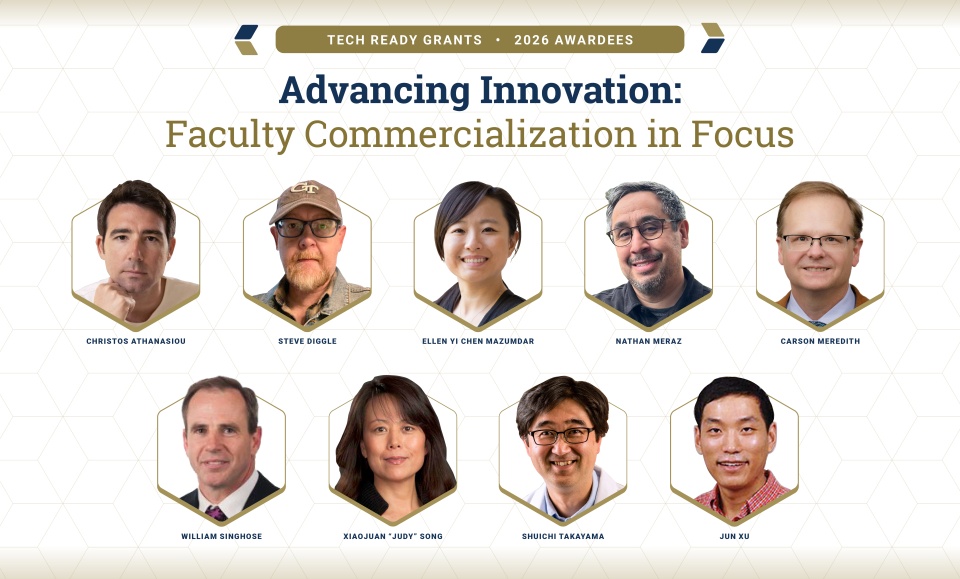
Two Georgia Tech Research Institute (GTRI) researchers are among the latest Georgia Tech innovators selected for Tech Ready Grants, an Office of Technology Licensing program designed to help promising technologies move closer to commercialization and real-world impact.
Nathan Meraz, a Senior Research Scientist in EOSL, and Xiaojuan “Judy” Song, a Principal Research Engineer in ATAS, were selected for projects that reflect GTRI’s applied research mission to leverage its science and engineering expertise, in collaboration with Georgia Tech, to enhance the impact of our collective research output. developing technologies that can move beyond the laboratory and into use by government, industry, healthcare providers, and other end users.
Nathan Meraz - SCHORTY Technical Document and Market Analysis
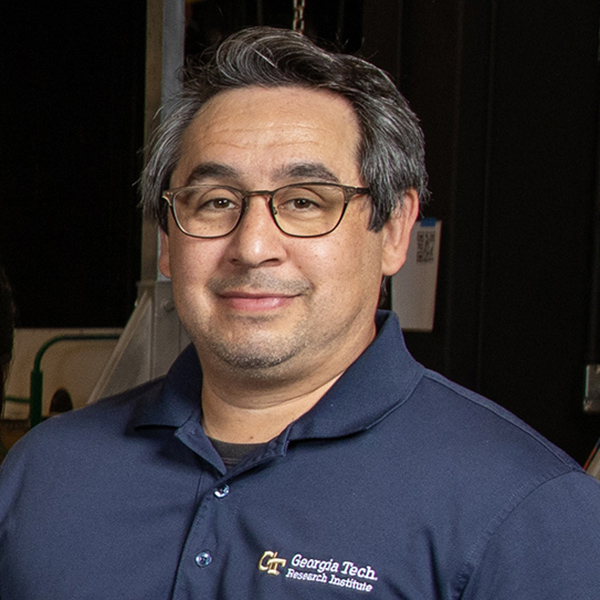
Meraz’s project, SCHORTY Technical Document and Market Analysis, focuses on Scheimpflug Optical Ranging Technology, or SCHORTY. The platform is designed to provide LiDAR-class 3D sensing in a camera-native form factor, with potential applications in remote sensing, object tracking, environmental mapping, and other fields where compact, lower-cost sensing systems could offer new capabilities.
“Our platform delivers performance that scales with advances in imaging technology,” Meraz said in the Georgia Tech announcement. “The Tech Ready Grant will support the transition from technical validation to market discovery.”
The grant will help Meraz identify high-value commercial applications and validate market opportunities for the technology. That step is especially important for research that has already shown technical promise but must still be matched with users, use cases, and commercialization pathways.
Meraz has been part of GTRI work exploring new applications for the Scheimpflug principle, an optical concept more than a century old that researchers are adapting for modern sensing challenges. In a recent GTRI story, he described the approach as an alternative to traditional time-of-flight LiDAR, noting that a camera-based sensor can provide different kinds of information for processing and data fusion.
Judy Song - Smart Dressing for Wound Monitoring

Song’s project, Smart Dressing for Wound Monitoring, advances a wearable smart dressing that would allow continuous, on-patient monitoring of wound healing without disturbing the wound site. The technology is designed for chronic wound care, including diabetic foot ulcers, and may also have battlefield medical applications
“Tech Ready funding will help advance the technology toward real-world application and define a commercialization pathway,” Song said.
Song’s work builds on a broader GTRI and Georgia Tech effort to develop a flexible, low-cost sensor that can be embedded in a bandage to monitor wound healing in real time. The system is intended to reduce unnecessary bandage changes, support earlier medical intervention, and give clinicians better insight into whether a wound is improving or showing signs of trouble.
That focus connects directly with Song’s broader research background in chemical and biological sensing. Her GTRI work has included sensor platforms for agricultural, poultry, clinical, environmental, and food safety applications. In a Georgia Tech “Faces of Research” profile, Song described GTRI’s role as going beyond ideas to help customers develop commercial products, build prototypes, and conduct real-world performance testing.
The Tech Ready Grants program supports exactly that transition point. According to Georgia Tech, the grants provide early-stage funding to help researchers pursue prototype development, validation, and market assessment. The program is intended to position technologies for licensing, startup formation, industry partnerships, and broader impact.
This year’s grants span advanced manufacturing, biotechnology, medical devices, sustainability, software systems, and other fields.
Read more about the other Tech Ready Grant recipients.
Writer: Christopher Weems
GTRI Communications
Georgia Tech Research Institute
Atlanta, Georgia, USA
About the Georgia Tech Research Institute (GTRI)
The Georgia Tech Research Institute (GTRI) is the nonprofit, applied research division of the Georgia Institute of Technology (Georgia Tech). Founded in 1934 as the Engineering Experiment Station, GTRI has grown to more than 3,000 employees, supporting eight laboratories across more than 20 locations nationwide and performing more than $919 million in problem-solving research annually for government and industry. GTRI's renowned researchers combine science, engineering, economics, policy, and technical expertise to solve complex problems for the U.S. federal government, state, and industry.

Related News