
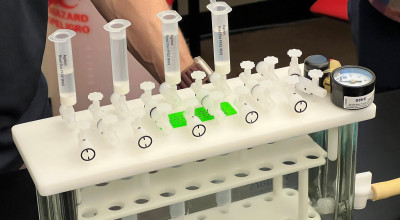





Nebulizer produces an aerosol that will produce particles for study.

Monitoring Technology Would Detect Airborne Pathogens in Buildings

11.18.2025
Researchers are developing new technologies to help detect airborne pathogens in the air circulating within buildings.

Related News

News stories
GTRI researchers are developing new ways to detect, remove, and break down PFAS, helping Georgia communities better understand and manage contamination risks of these 'forever chemicals.'
News stories
While viewers watched NASA’s Artemis II crew return to Earth off the coast of San Diego on April 10, 2026, Georgia Tech Research Institute (GTRI) researchers were listening in a different way.
News stories
Artificial intelligence (AI) chatbots can give people a comfortable place to discuss personal thoughts and feelings. However, when a chatbot constantly agrees with a user, it can reinforce false beliefs and potentially cause harm. New research from Georgia Tech suggests that a simple change to a chatbot’s instructions could reduce that risk.
Researchers work on an APAT array

Adaptive Phased Array Antenna Supports Hypersonic Flight Testing

10.23.2025
When future hypersonic vehicles are tested far above the Pacific Ocean, the telemetry signals they transmit will be captured by a new type of modular antenna system known as APAT.

Related News

News stories
GTRI researchers are developing new ways to detect, remove, and break down PFAS, helping Georgia communities better understand and manage contamination risks of these 'forever chemicals.'
News stories
While viewers watched NASA’s Artemis II crew return to Earth off the coast of San Diego on April 10, 2026, Georgia Tech Research Institute (GTRI) researchers were listening in a different way.
News stories
Artificial intelligence (AI) chatbots can give people a comfortable place to discuss personal thoughts and feelings. However, when a chatbot constantly agrees with a user, it can reinforce false beliefs and potentially cause harm. New research from Georgia Tech suggests that a simple change to a chatbot’s instructions could reduce that risk.
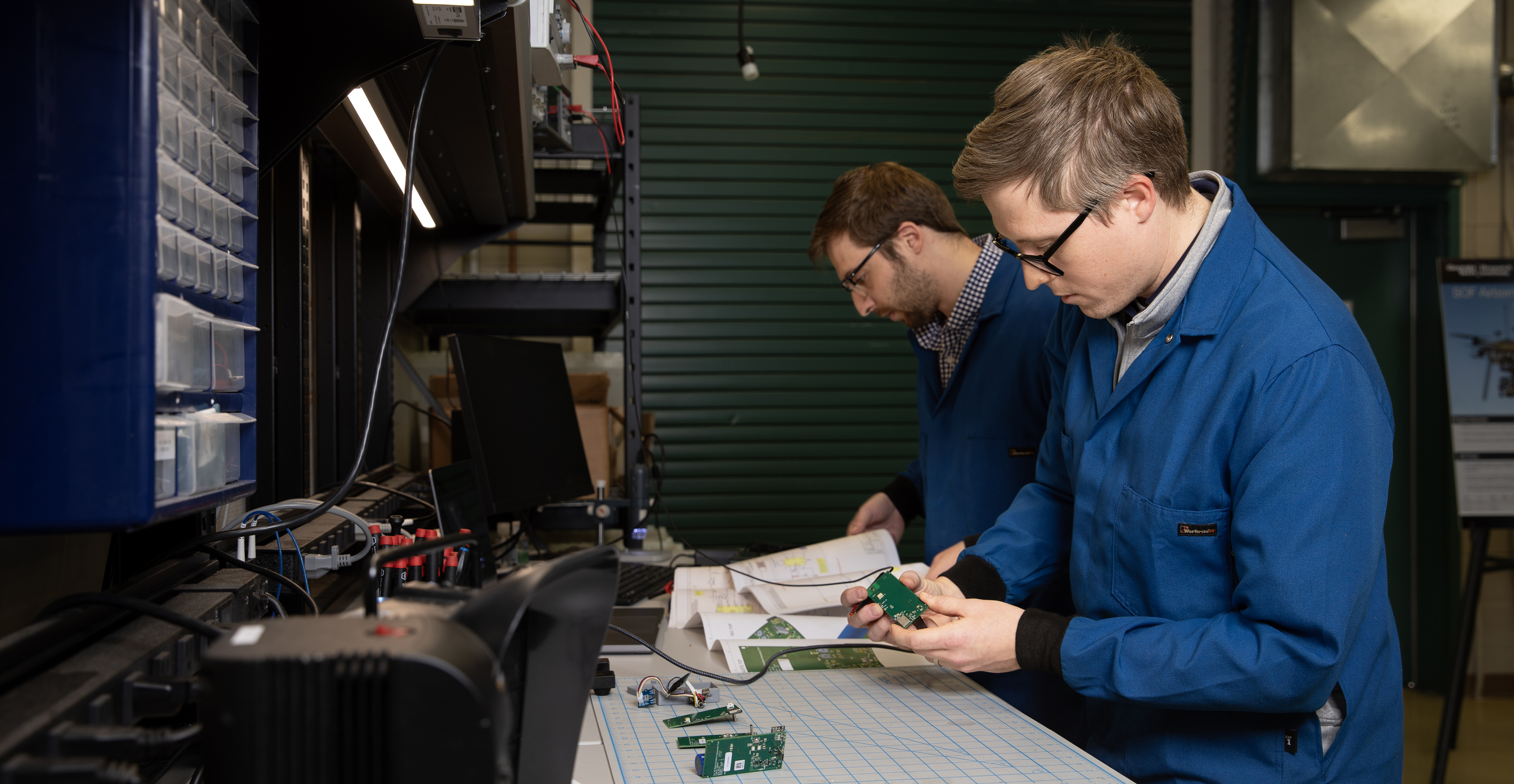
GTRI researchers test printed circuit boards

Mold Conditions Awareness Tool (MCAT) Could Protect Soldier Barracks

01.21.2025
Ingenuity from a group of soldiers stationed at Fort Stewart – and help from engineers at the Georgia Tech Research Institute (GTRI) – has produced a possible solution for an issue that affects personnel at multiple U.S. Army facilities located in areas with high humidity and temperatures.

Related News

News stories
GTRI researchers are developing new ways to detect, remove, and break down PFAS, helping Georgia communities better understand and manage contamination risks of these 'forever chemicals.'
News stories
While viewers watched NASA’s Artemis II crew return to Earth off the coast of San Diego on April 10, 2026, Georgia Tech Research Institute (GTRI) researchers were listening in a different way.
News stories
Artificial intelligence (AI) chatbots can give people a comfortable place to discuss personal thoughts and feelings. However, when a chatbot constantly agrees with a user, it can reinforce false beliefs and potentially cause harm. New research from Georgia Tech suggests that a simple change to a chatbot’s instructions could reduce that risk.
IEEE logo

Eric Grigorian Featured in IEEE Spectrum

12.08.2024
Eric Grigorian, Chief of the Architecture & Systems Development Division in the Applied Systems Laboratory (ASL), is featured in the November 2024 issue of IEEE Spectrum, the journal of the Institute of Electrical and Electronics Engineers (IEEE).

Related News

News stories
GTRI researchers are developing new ways to detect, remove, and break down PFAS, helping Georgia communities better understand and manage contamination risks of these 'forever chemicals.'
News stories
While viewers watched NASA’s Artemis II crew return to Earth off the coast of San Diego on April 10, 2026, Georgia Tech Research Institute (GTRI) researchers were listening in a different way.
News stories
Artificial intelligence (AI) chatbots can give people a comfortable place to discuss personal thoughts and feelings. However, when a chatbot constantly agrees with a user, it can reinforce false beliefs and potentially cause harm. New research from Georgia Tech suggests that a simple change to a chatbot’s instructions could reduce that risk.
A photo of an electric vehicle at a charging station.

GTRI Enhancing EV Battery Reuse and Recycling in Georgia

06.02.2023
GTRI is optimizing Georgia’s EV battery supply chain by developing cost- and energy-efficient methods to recover materials from spent batteries so that more of them can be reused and pose fewer environmental risks.

Related News

News stories
GTRI researchers are developing new ways to detect, remove, and break down PFAS, helping Georgia communities better understand and manage contamination risks of these 'forever chemicals.'
News stories
While viewers watched NASA’s Artemis II crew return to Earth off the coast of San Diego on April 10, 2026, Georgia Tech Research Institute (GTRI) researchers were listening in a different way.
News stories
Artificial intelligence (AI) chatbots can give people a comfortable place to discuss personal thoughts and feelings. However, when a chatbot constantly agrees with a user, it can reinforce false beliefs and potentially cause harm. New research from Georgia Tech suggests that a simple change to a chatbot’s instructions could reduce that risk.

Black History Month Spotlight: Celebrating ECE’s Black Voices

Georgia Tech School of Electrical and Computer Engineering
https://www.ece.gatech.edu/news/665682/black-history-month-spotlight-celebratin…

The Georgia Tech School of Electrical & Computer Engineering recently featured William H. Robinson, GTRI Deputy Director for Research for Information and Cyber Sciences Directorate (ICSD) and ECE Professor.

Four GTRI researchers selected as DARPA Risers

Georgia Tech/GTRI Researchers Recognized as DARPA Risers

11.14.2022
A dozen Georgia Institute of Technology researchers, including four from the Georgia Tech Research Institute (GTRI), were recognized as DARPA Risers during the agency’s recent DARPA Forward conference in Atlanta.

Related News

News stories
GTRI researchers are developing new ways to detect, remove, and break down PFAS, helping Georgia communities better understand and manage contamination risks of these 'forever chemicals.'
News stories
While viewers watched NASA’s Artemis II crew return to Earth off the coast of San Diego on April 10, 2026, Georgia Tech Research Institute (GTRI) researchers were listening in a different way.
News stories
Artificial intelligence (AI) chatbots can give people a comfortable place to discuss personal thoughts and feelings. However, when a chatbot constantly agrees with a user, it can reinforce false beliefs and potentially cause harm. New research from Georgia Tech suggests that a simple change to a chatbot’s instructions could reduce that risk.