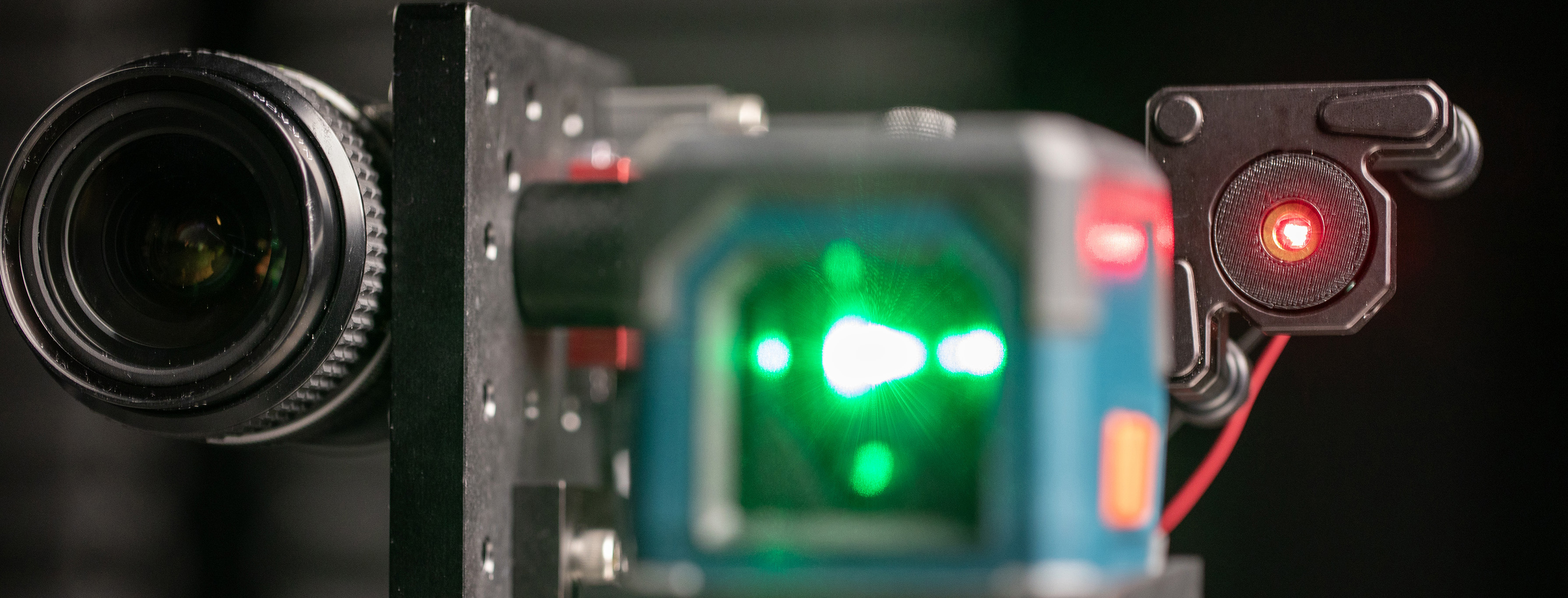
An optical principle discovered more than a century ago may soon find new applications in such areas as monitoring atmospheric turbulence, tracking airborne objects, and mapping the environment, thanks to researchers at the Georgia Tech Research Institute (GTRI).
Applying the Scheimpflug technique, the researchers are developing inexpensive rangefinder camera technology, advanced sensors and computational techniques to both complement and provide an alternative to established light detection and ranging (LiDAR) technology in certain applications. The technique works best in short- and medium-distance metrology and can be used passively or in collaboration with laser-based techniques.
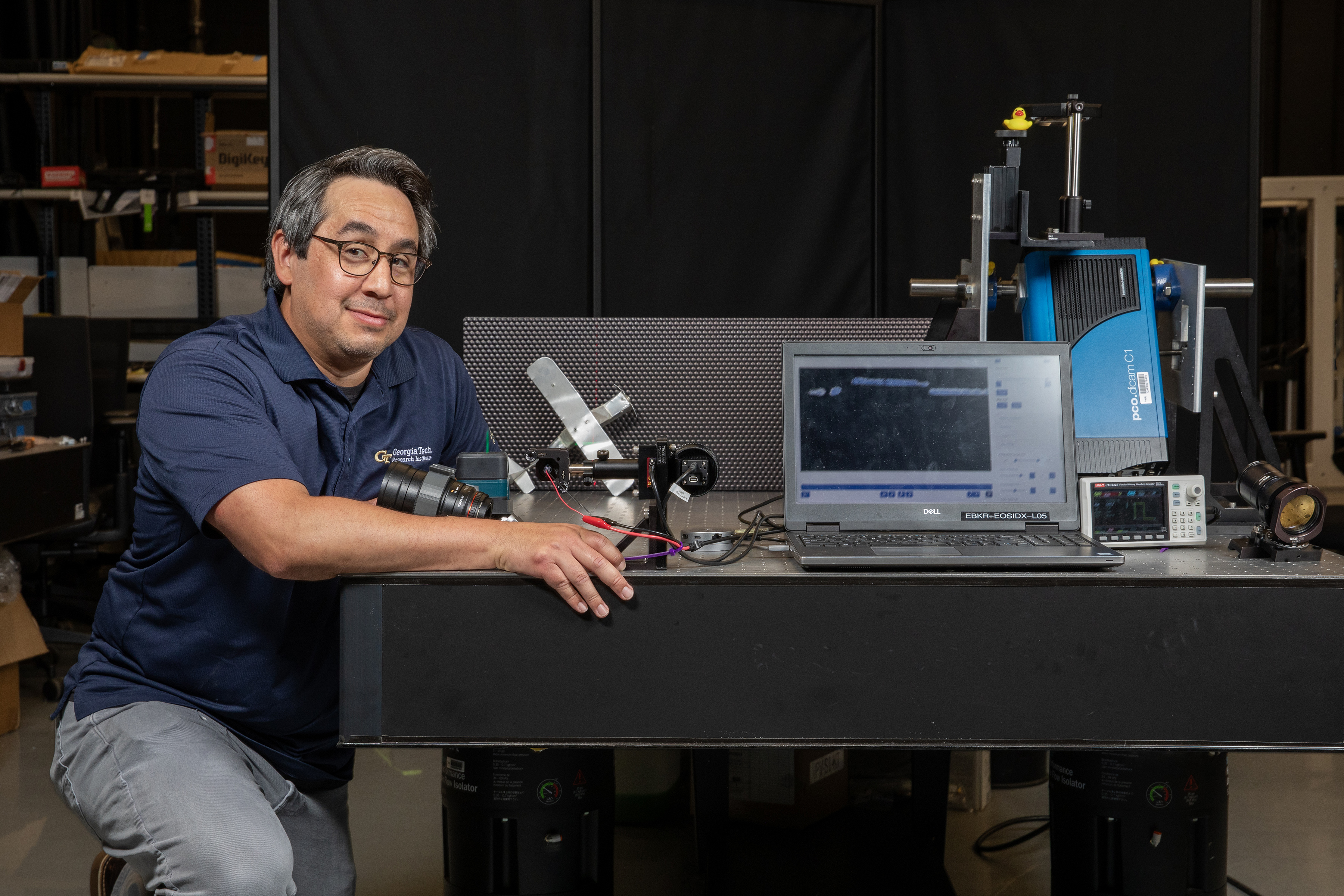
“The Scheimpflug technique is a complete alternative to time-of-flight (ToF) LiDAR, and we’re looking for everything we can do with it,” said Nathan Meraz, a GTRI senior research scientist who has been refining the new applications for several years. “It measures things differently, and since it’s a camera sensor, there’s a lot more information to process compared to a LiDAR signal. And there are also data fusion aspects.”
A paper on the technique and its potential remote sensing applications was presented during 2025 at the SPIE Defense + Commercial Systems (DCS) Conference. The research was supported by GTRI’s Independent Research and Development (IRAD) program and also has been advanced by teams of student researchers from the GTRI Research Internship Program (GRIP).

The optical principle that is the basis for the Scheimpflug technique was popularized in the early 1900s and led to several patented optical devices by an Austrian photographer, Theodor Scheimpflug, who wanted to use it to correct for the perspective distortion in aerial imagery.
The technique depends on the relationship between a camera’s image plane (where film or imaging sensors are located), the camera’s lens plane (which is determined by how the optics are arranged), and the area in focus – such as a building or landscape. The basic principle is already used in ophthalmology, perspective correction, and extended depth of field imaging, and the GTRI researchers hope to break new ground with the improvements they are developing in readapting the principle for static monocular 3D imaging.
“Whereas LiDAR uses advanced electronics to monitor how the laser emissions propagate, Scheimpflug uses a much simpler principle where by tilting our camera, we can start resolving along the optical axis along which light propagates through the atmosphere,” said GTRI Research Engineer Joseph Greene, who is also working on the project. “Instead of needing to time an optical signal to determine where it is in space, we can use this simple configuration to figure out where the signal is located.”
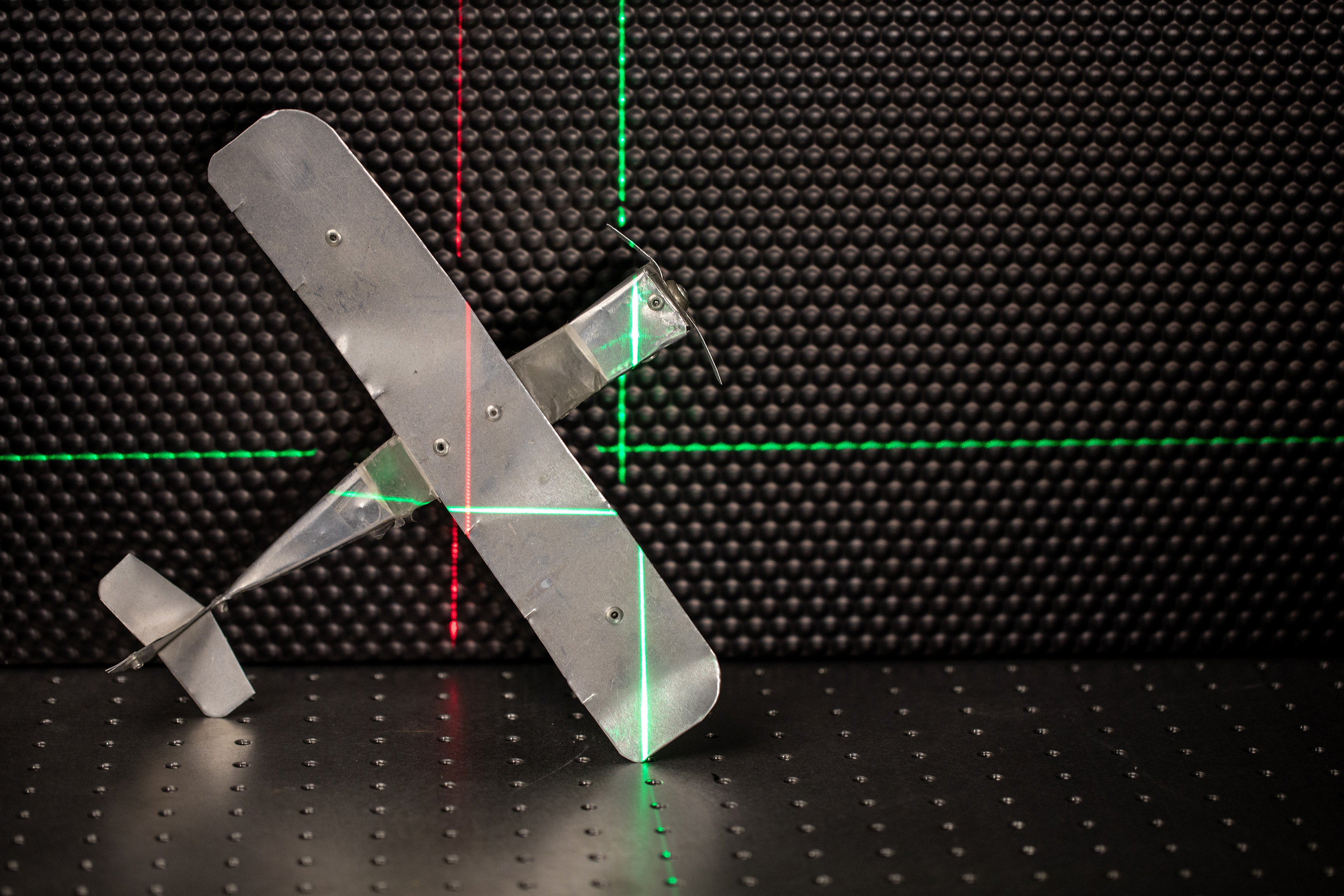
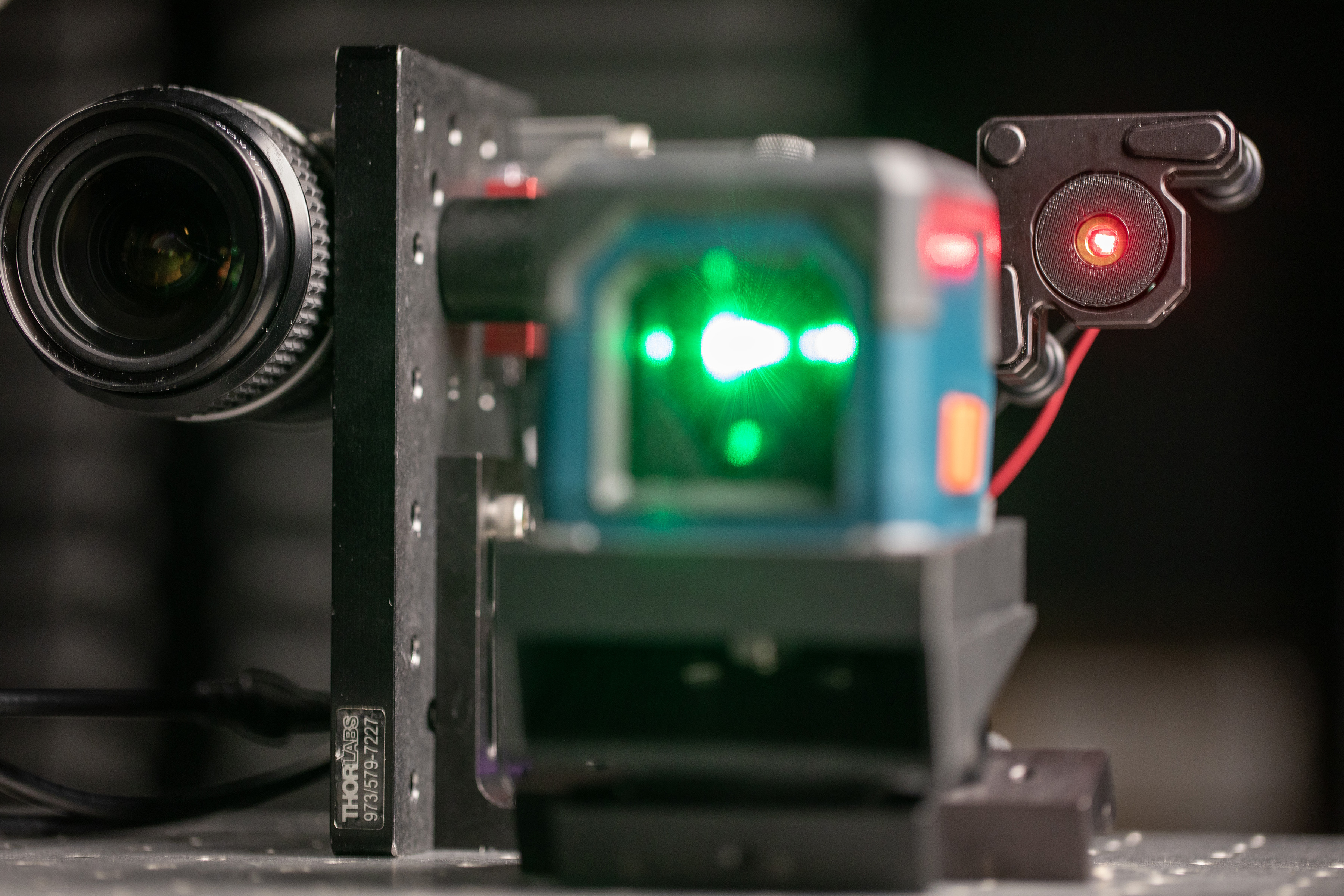
The GTRI researchers are using event-based cameras that capture information on changes in the brightness of individual pixels in a camera’s imaging sensor – without using the shutters found in conventional cameras. Analyzing the pixel data produces microsecond resolution, and combined with novel range-finding algorithms, improves the ability to isolate optical signals to the calibrated ranges of the camera. ToF methods require fast detectors, high-speed timing and digitizing electronics, and pulsed or modulated lasers that make the systems complex and expensive.
The system being developed may be flexibly adapted for direct observation and ranging for active and passive remote sensing applications and may be used independently or enhanced by combining it with laser technology. Use of the Scheimpflug technique instead of ToF could reduce the size, weight, and power-cost (SWaP-C) of systems required for the applications.
Scheimpflug LiDARs that combine the technologies could have intrinsically lower dynamic range requirements, improved range resolution and ranging performance, the ability to work with continuous wave lasers or pulsed lasers, and flexibility for use with a variety of wavelengths, Meraz said.
While LiDARs are often used for such applications as studying atmospheric turbulence, the GTRI team is evaluating the Scheimpflug technique for dynamic object tracking where their ability to provide information at closer ranges could be particularly useful.
"The passive system proves highly useful for atmospheric measurements, particularly because atmospheric LiDARs tend to perform sub-optimally at close ranges," said Megan Birch, a GTRI research scientist who is also part of the research team. "As with all sensor systems designed for various applications, we continue to explore innovative ways to leverage the Scheimpflug technique."
The GTRI researchers have built multiple Scheimpflug LiDARs for testing. In 2024, the research team demonstrated their Scheimpflug Optical Ranging Technology (SCHORTY) which is designed to observe and measure range-resolved atmospheric effects on a propagating laser beam at ranges from six meters up to four kilometers.
In another application, the camera was operated along with a conventional atmospheric LiDAR to capture images of a laser beam, allowing direct comparison of measurements. In simultaneous experiments using the ToF LiDAR and imaging the same laser beam, they saw the value and performance capability of a prototype system operating at a 355-nanometer wavelength. Without models beyond the pixel-range map, they created range profiles with enough sensitivity to visually observe the atmospheric effects from extinction and turbulence.
Similarly, a smaller beam of a 532-nanometer prototype was extremely sensitive to turbulence and easily observable beam wander and scintillation effects occurring on the live video, the researchers found.
Looking ahead, the researchers hope to continue developing the SCHORTY instrument for atmospheric monitoring, and to examine other applications for the technology.
“At this point, we know how to model it, what the drawbacks are, where the advantages will be and are talking with people about other technical problems where Scheimpflug might fit in,” Meraz said. “These applications are new, so they’re not in a textbook or a short course you can attend. But there’s a huge feature space that we may be able to exploit and are looking forward to what else we can discover.”
Writer: John Toon (john.toon@gtri.gatech.edu)
GTRI Communications
Georgia Tech Research Institute
Atlanta, Georgia USA
About the Georgia Tech Research Institute (GTRI)
The Georgia Tech Research Institute (GTRI) is the nonprofit, applied research division of the Georgia Institute of Technology (Georgia Tech). Founded in 1934 as the Engineering Experiment Station, GTRI has grown to more than 3,000 employees, supporting eight laboratories in over 20 locations around the country and performing more than $919 million of problem-solving research annually for government and industry. GTRI's renowned researchers combine science, engineering, economics, policy, and technical expertise to solve complex problems for the U.S. federal government, state, and industry.

Related News