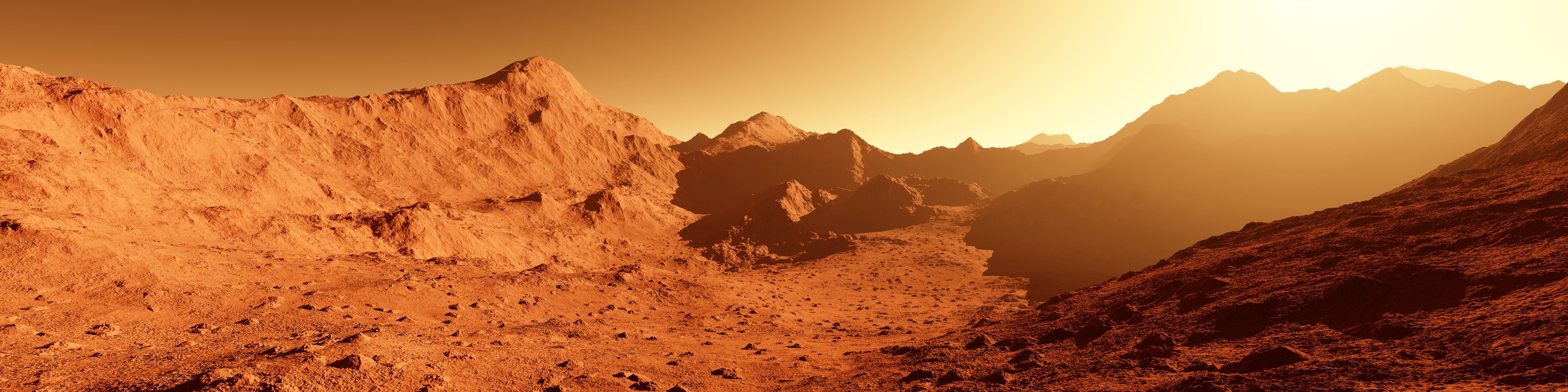
Rocky desert landscape with mountain ridges under a golden-orange hazy sky, resembling Mars or an arid alien terrain at sunset.

Georgia Tech Students Run First U.S.-Based, Student-Led Analog Space Mission

08.31.2026

Earlier this month, six students went to Mars.

For 10 days, they conducted experiments, managed limited resources, and lived in isolation while learning what it’s like to be an astronaut.

Except they were not actually on Mars. They were at Titan Ranch in Arkansas, participating in the inaugural mission of Georgia Tech’s Southeast Analog (SEA), the first completely student-led analog astronaut program in the United States.

Analog missions simulate long-duration spaceflight, helping researchers better understand how humans can live and work in extreme environments such as Mars and the moon. During the mission, students experienced many of the same challenges future astronauts may face, including communication delays, isolation, and teamwork under pressure.

But the six analog astronauts weren’t the only students involved. More than 30 Georgia Tech students staffed a full mission-control center on campus, where they monitored astronauts, tracked experiments, and practiced real-world flight operations procedures. To mimic the distance between Earth and Mars, communications between the astronauts and mission control were delayed by 20 minutes each way.

For the students involved, the mission offered a rare opportunity to gain hands-on experience in human spaceflight — without the financial and geographic barriers often associated with international analog astronaut programs.

Read the full story on the Georgia Tech Research News site.

Newsletter

Sign up for monthly updates on GTRI’s research, activity, and more.

Related News

News stories
Just one year after building portable UV disinfection chambers to address the personal protection equipment (PPE) shortage amid Covid-19, GTRI Research Engineer Robert Harris is already planning for the next potential pandemic. Harris is researching UV water disinfection as another tool to save lives and hopes to educate others about how to use the technology safely and effectively.
News stories
The Georgia Tech Research Institute (GTRI) is working to improve search and rescue capabilities for the Air Force through the government's Multi-Spectral Intelligence, Surveillance, and Reconnaissance (MISeR) program. By attaching an electro-optical infrared sensor system from Northrop Grumman to Airdyne Aerospace’s Special Airborne Mission Installation & Response (SABIR) arm, the Air Force can better perform combat search and rescue (CSAR) missions.
News stories
Col. Erik Andersen has served in the U.S. Army, Georgia National Guard, and the Atlanta Police Department. He met GTRI recruiters at a recent virtual career fair in January 2021 and advocated for a program called Hiring Our Heroes (HOH), which helps veterans and families of military members find civilian employment. He sees GTRI as a good place for combining his heart for service and entrepreneurial spirit.