


Earlier this month, six students went to Mars.
For 10 days, they conducted experiments, managed limited resources, and lived in isolation while learning what it’s like to be an astronaut.
Except they were not actually on Mars. They were at Titan Ranch in Arkansas, participating in the inaugural mission of Georgia Tech’s Southeast Analog (SEA), the first completely student-led analog astronaut program in the United States.
Analog missions simulate long-duration spaceflight, helping researchers better understand how humans can live and work in extreme environments such as Mars and the moon. During the mission, students experienced many of the same challenges future astronauts may face, including communication delays, isolation, and teamwork under pressure.
But the six analog astronauts weren’t the only students involved. More than 30 Georgia Tech students staffed a full mission-control center on campus, where they monitored astronauts, tracked experiments, and practiced real-world flight operations procedures. To mimic the distance between Earth and Mars, communications between the astronauts and mission control were delayed by 20 minutes each way.
For the students involved, the mission offered a rare opportunity to gain hands-on experience in human spaceflight — without the financial and geographic barriers often associated with international analog astronaut programs.
Read the full story on the Georgia Tech Research News site.

Related News
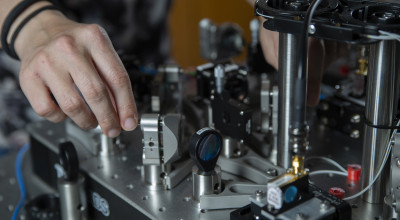
Trapped ions excited with a laser beam can be used to create entangled qubits in quantum information systems, but addressing several stationary pairs of ions in a trap requires multiple optical switches and complex controls.
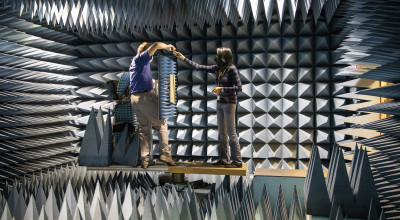
Digitally-reconfigurable modular hardware and software building blocks designed to work together are key components of GTRI’s Software-Defined Configurable RF Array (COBRA) initiative, which is intended to facilitate rapid development of low-cost phased-array radar systems for ground, airborne, spaceborne, electronic warfare, communication, and other applications.

A new and comprehensive database of healthcare claims paid in the state of Georgia will help identify disease trends, provide information for making public policy decisions, facilitate new research – and offer a way for consumers to determine the average cost of common procedures such as knee replacement or diagnostic testing such as MRIs.