
Earlier this month, six students went to Mars.
For 10 days, they conducted experiments, managed limited resources, and lived in isolation while learning what it’s like to be an astronaut.
Except they were not actually on Mars. They were at Titan Ranch in Arkansas, participating in the inaugural mission of Georgia Tech’s Southeast Analog (SEA), the first completely student-led analog astronaut program in the United States.
Analog missions simulate long-duration spaceflight, helping researchers better understand how humans can live and work in extreme environments such as Mars and the moon. During the mission, students experienced many of the same challenges future astronauts may face, including communication delays, isolation, and teamwork under pressure.
But the six analog astronauts weren’t the only students involved. More than 30 Georgia Tech students staffed a full mission-control center on campus, where they monitored astronauts, tracked experiments, and practiced real-world flight operations procedures. To mimic the distance between Earth and Mars, communications between the astronauts and mission control were delayed by 20 minutes each way.
For the students involved, the mission offered a rare opportunity to gain hands-on experience in human spaceflight — without the financial and geographic barriers often associated with international analog astronaut programs.
Read the full story on the Georgia Tech Research News site.

Related News

Women in Technology (WIT) named GTRI Principal Research Scientist Jill Gostin one of its Women of the Year in Technology.
Gostin, who joined GTRI in 1985, won WIT’s Women of the Year in Technology in the Medium Business category at the annual WIT Awards ceremony on Nov. 10. WIT also named winners in the Large Business, Small Business and Non-Profit categories.
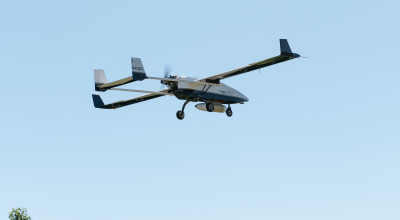
The Georgia Tech Research Institute (GTRI) has acquired two TigerShark unmanned aerial vehicles to support its research on airborne multi-sensor technologies. The UAVs have been flown and tested with a four-channel multimode radar that can be operated in both monostatic and bistatic configurations.