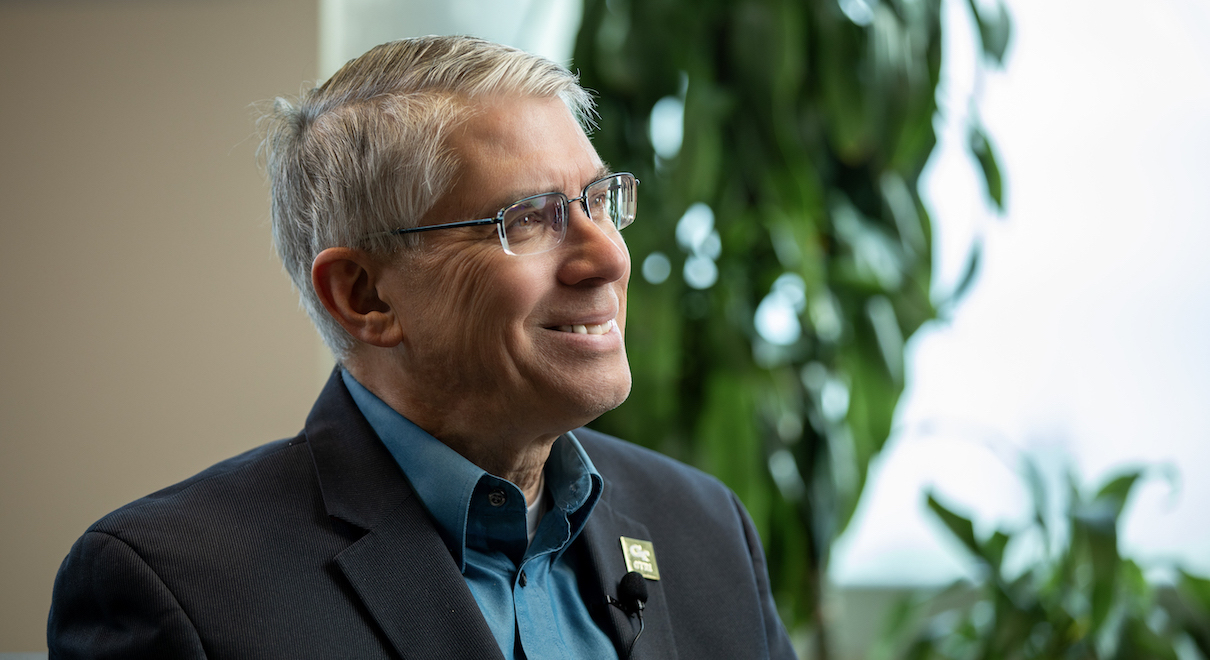
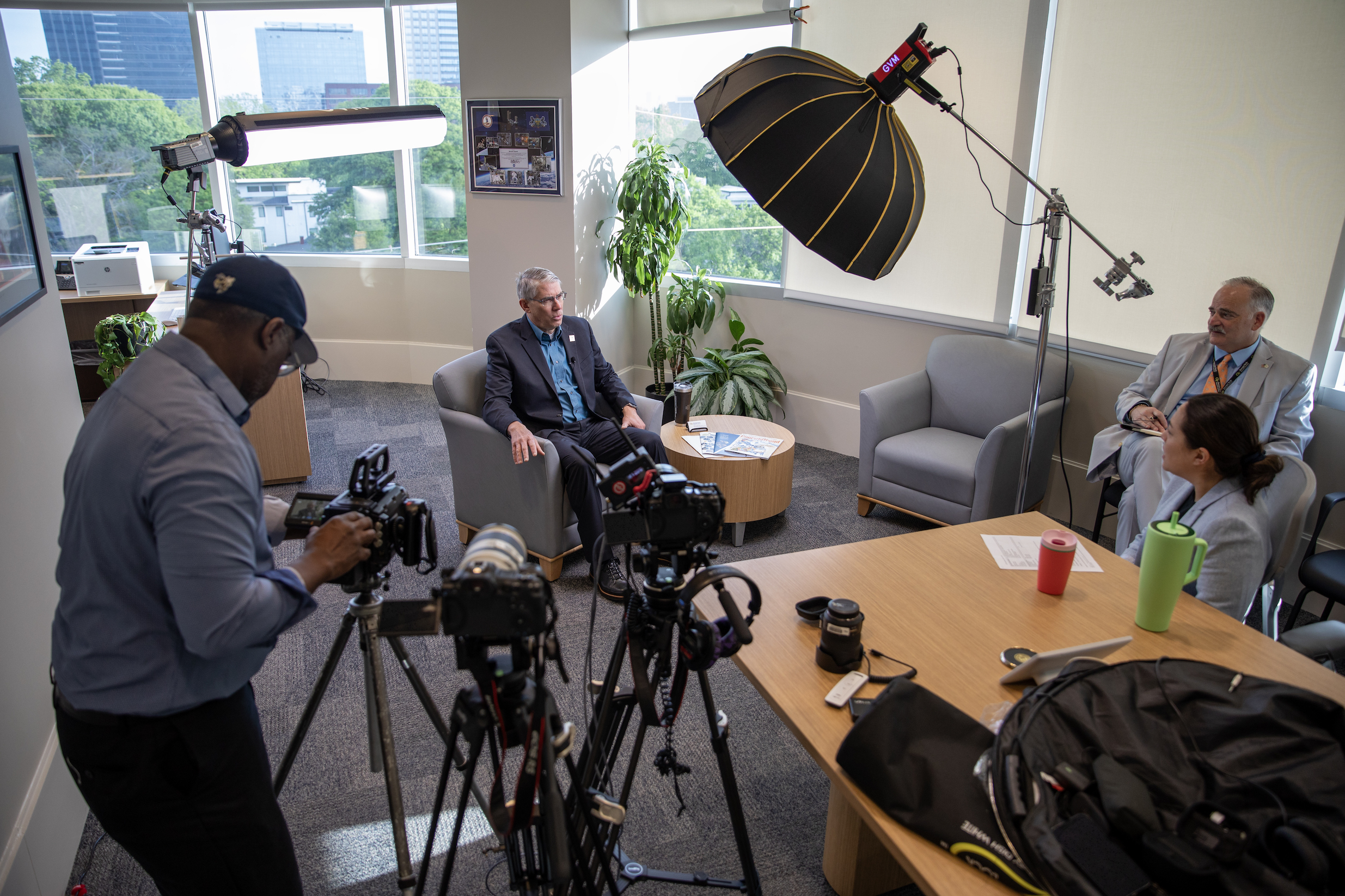
The latest episode of the Georgia Tech Research Podcast features a conversation with Mike Gazarik, Ph.D., director of the Georgia Tech Research Institute (GTRI) and senior vice president at Georgia Tech.
Hosted by GTRI researcher Stephanie Richter (ATAS), the episode introduces Mike as GTRI enters what Richter describes as “a new chapter of innovation and global impact.”
During the discussion, Mike reflects on his professional journey, his return to Georgia Tech, his early priorities as director, and the leadership philosophy he brings to the role.
Mike expresses his pride in being a “double Jacket,” having earned both his master’s and Ph.D. in electrical engineering from Georgia Tech.
He says his time at Georgia Tech was an important part of his professional transformation and helped shape a career that later included technical, program management, engineering leadership, and executive roles at organizations including MIT Lincoln Laboratory, NASA, Ball Aerospace, and the University of Colorado.
“This opportunity came up to come back to the Georgia Tech community,” Gazarik sad. “I wasn’t really going to be interested in something that I had no connection with.”
Now back at Georgia Tech and GTRI, Gazarik said he is focused first on listening and learning. He described his first 90 days as a deliberate effort to meet people, understand the work, and learn more about GTRI’s talent, campus connections, sponsors, stakeholders, and GTRI’s Field Offices.
“I set apart my first 90 days, which I’m about 60 days in, meeting people, learning about the work and, more importantly, learning about the incredible talent we have here at GTRI,” he said.
In the podcast episode, Mike also says his vision begins by building on GTRI’s existing strengths, especially its ability to deliver practical solutions rapidly to meet national security needs. He emphasized that GTRI is operating in a high-stakes environment and must continue to become faster, more agile, and more responsive to changing sponsor priorities.
“We deliver incredible solutions rapidly for our nation’s security,” he said. “We’re in a wartime setting right now, more relevant than ever. We want to build upon that.”
He also discussed opportunities to expand GTRI’s impact through industry partnerships, space-related applications, cross-laboratory collaboration, and emerging mission areas. He noted that GTRI is developing plans around several integrated mission priorities, including Golden Dome for America, unmanned aerial systems (UAS), counter-UAS, mission engineering, and artificial intelligence.
Mike also spoke about his leadership style, which he said has evolved over time. Early in his career, he was focused on being a technical performer and “getting stuff done.” A colleague once told him, “Mike, I’ll give you this. You get things done, but could you be more graceful?” That comment stayed with him.
Over time, he said, his approach matured into a servant-leadership model focused on helping organizations and people succeed.
“I want to get things done, but try to be ‘graceful,’” Gazarik said.
For early-career professionals, Mike offers two pieces of advice: begin developing leadership skills early and build resiliency. Leadership, he said, can be practiced through formal roles, volunteer work, mentoring, reading, teaching, or other forms of learning. Resiliency is equally important because adversity is inevitable.
“We’re all going to face adversity, whether it be organizationally or personally,” he said. “The faster you can [recover], the more successful you’ll be.”
The episode also touches on GTRI’s current challenges and opportunities. Gazarik said the organization must stay focused on agility, resilience, and speed while also addressing internal issues, such as compensation, retention, and employee frustration, where possible. He said he has been encouraged by what he has seen during his listening tour and by recent interactions with external stakeholders.
He also emphasized GTRI’s strong culture, mission focus, and technical capability.
“It’s a great organization,” he said. “We’re people-focused. Culture is super important to us and we will continue to enhance it.”
Gazarik said he plans to build on GTRI’s sponsor relationships by engaging more directly with executives and decision-makers in Washington, D.C., as well as at other agencies and field offices. His goal, he said, is to help tell GTRI’s story at a higher level and highlight the Institute’s ability to contribute at the mission and architecture level.
“We think we can do more for them, especially at the mission level and at the architecture level,” he said.
The conversation also includes personal reflections on Gazarik’s time as a Georgia Tech student, including memories of baseball games, studying in the library, spending time in the Olympic Village, and a formative digital signal processing class. He said Georgia Tech helped reinforce a mindset of solving difficult problems, working through constraints, and finding ways to get things done.
“We figure stuff out,” he said. “We get stuff done. We understand how things work.”
Writer: Christopher Weems
GTRI Communications
Georgia Tech Research Institute
Atlanta, Georgia, USA
About the Georgia Tech Research Institute (GTRI)
The Georgia Tech Research Institute (GTRI) is the nonprofit, applied research division of the Georgia Institute of Technology (Georgia Tech). Founded in 1934 as the Engineering Experiment Station, GTRI has grown to more than 3,000 employees, supporting eight laboratories across more than 20 locations nationwide and performing more than $919 million in problem-solving research annually for government and industry. GTRI's renowned researchers combine science, engineering, economics, policy, and technical expertise to solve complex problems for the U.S. federal government, state, and industry.

Related News