Today, unmanned aerial vehicles (UAVs) are a rapidly growing part of military operations, and forces that aren't prepared to deal with them are vulnerable. To protect its ground forces, the United States military must be prepared to counter the surveillance technologies aboard hostile unmanned aircraft.
As part of its broad-based work in electronic-warfare technologies, the Georgia Tech Research Institute (GTRI) is developing integrated hardware devices that simulate sensors potentially present on enemy UAVs. The technology – produced by GTRI as part of its Threat Unmanned Devices Program – is expected to be used to gauge the effectiveness of U.S. countermeasures against enemy drones. The research is sponsored by the U.S. Army Threat Systems Management Office.
"The assets that we're building can simulate the threat capability you would expect on a foreign unmanned aerial vehicle," said Vince Camp, a GTRI senior research engineer who is a principal investigator for the project. "We're reproducing the ISR [intelligence, surveillance and reconnaissance] capability that a threat UAV would have. Simulating this ISR capability makes it possible to test the effectiveness of U.S. countermeasures against a potentially hostile signal intelligence capability in the air."
When aloft, GTRI's integrated devices simulate three principal threat capabilities, said Doug Martin, a senior research engineer who directs the GTRI Threat Unmanned Devices Program. The simulated threats include an electro-optical infrared sensor package that includes thermal-imaging capability, other sensors that detect and analyze U.S. communication signals, and equipment capable of jamming U.S. weapons systems. Additional threat-simulation capabilities could be added in the future.
"The intent here isn't to shoot down a hostile UAV or even to prevent it from being there," Martin explained. "We want to know what information that vehicle is trying to gather, and what can be done to minimize the exposure of that information."
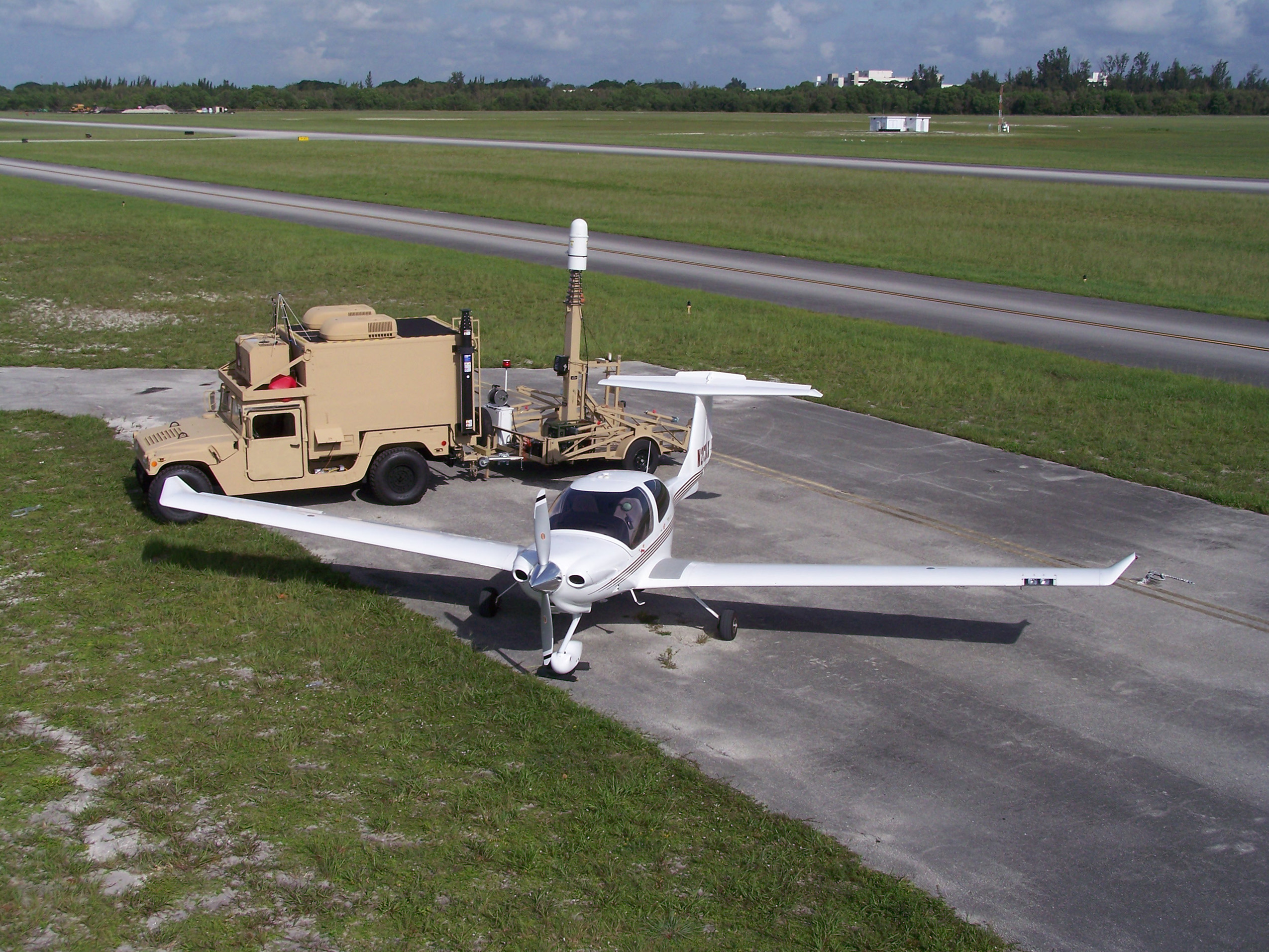
Currently, he noted, GTRI's threat simulator payload is being used on a Diamond DA-40 manned aircraft rather than a UAV. That's largely because the presence of a human pilot makes it easier to obtain clearance to fly over U.S. ground forces and ground assets at test ranges. Acquiring clearance for a UAV flyover is more difficult and time-consuming due to safety concerns.
After takeoff, the test aircraft is directed entirely by a ground operator. The human pilot simply executes the flight plan and commands sent from the ground, maintaining a human-in-the-loop in the event of an emergency.
The simulator devices are controlled from the ground via a FalconView interface, which also provides the pilot direction. FalconView is a widely used mapping system created by GTRI that displays maps and other information useful to military mission planners, aviators and aviation support personnel.
"From the standpoint of the ground operator, the manned aircraft will look and function like a UAV," Martin said. "The ground control interface makes it look like it's an autonomous vehicle up there."
The GTRI team has finished integration of the threat-simulation devices that are called for under current plans and has passed initial acceptance tests in the air. The completed system was demonstrated successfully at a missile range in fall 2012.
Eventually, Camp said, it's possible that GTRI's threat simulator hardware will be placed on true UAVs, which could be either ground-controlled or fully autonomous. Mounting a simulation payload on a UAV could provide a more complete, multi-function test environment.
"Currently, simulating threat UAV payload performance is the priority over simulating the signature of the aircraft," Camp said. "In the future, a test UAV platform could provide a more realistic radar cross-section, electro-optic/infrared signature and acoustic signature needed to provide a complete threat UAV test capability. What we learn from testing with the UAV threat simulator will help us deploy countermeasures more effectively."

Related News