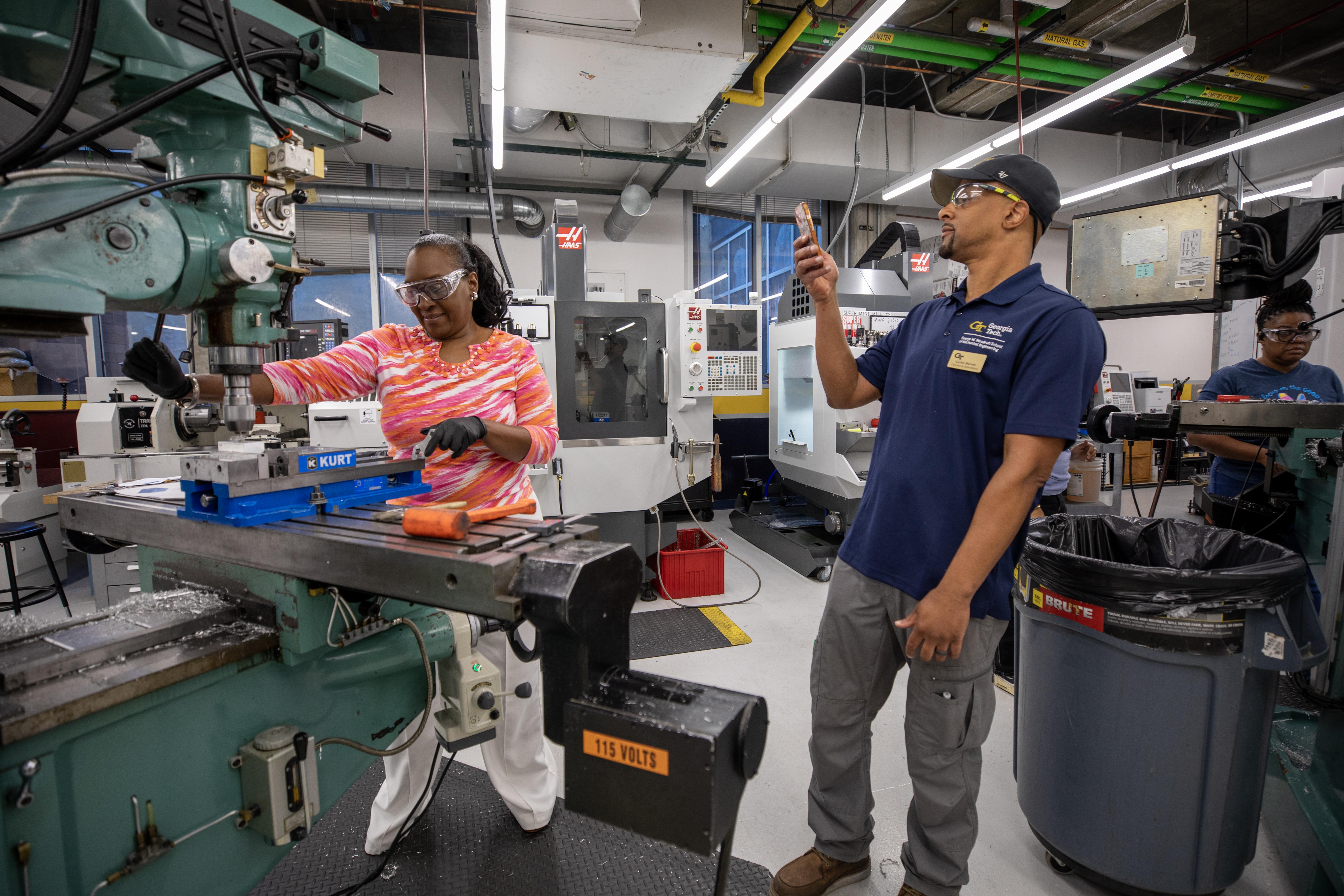
For three days in June, a dozen middle and high school teachers from rural Georgia traded their classrooms for Georgia Tech’s Montgomery Machining Mall, a machine shop where students and researchers design and build custom parts. Instead of grading papers, they cut metal on bandsaws, lathes, and milling machines while learning skills they’ll take back to their students this fall.
The workshop is part of Georgia Tech’s Advanced Manufacturing Pathways (AMP) program, a collaboration between the Georgia Tech Manufacturing Institute (GTMI) and Georgia Tech Research Institute (GTRI), which connects rural educators with hands-on manufacturing training. This particular training was delivered through a partnership between GTMI, STEM@GTRI — GTRI’s K-12 outreach program — and the George W. Woodruff School of Mechanical Engineering, leveraging the facilities and expertise of the Montgomery Machining Mall to provide teachers with direct experience in modern manufacturing. Building on GTRI’s Rural Computer Science Initiative, the program expands access to high-skill, high-wage career pathways across rural communities. The initiative is supported through state funding.
The workshop comes at a time when demand for skilled manufacturing workers continues to grow nationwide, particularly in roles requiring precision, technical expertise, and problem-solving.
Read the full story on the Georgia Tech Research news site.

Related News