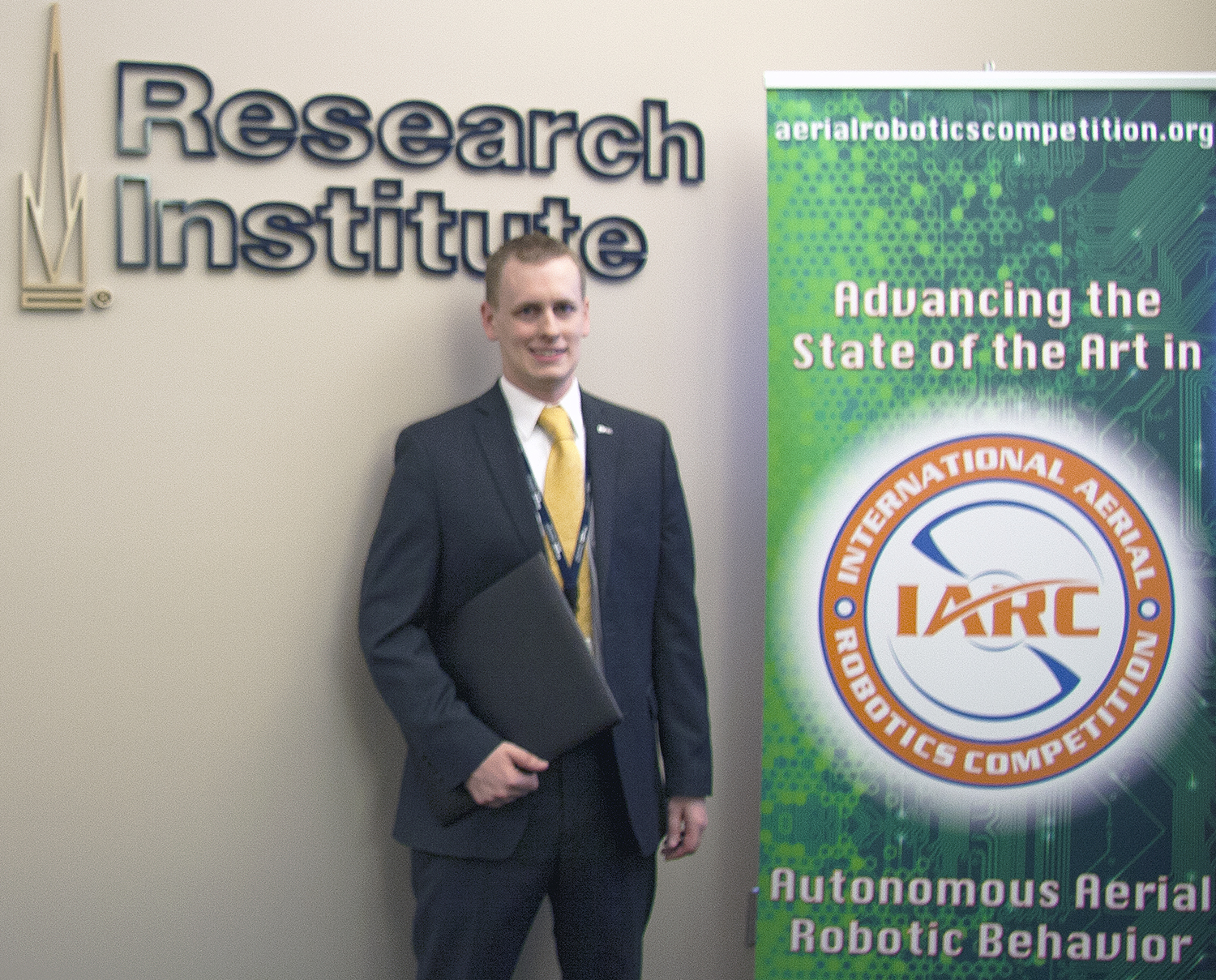
The Georgia State Senate adopted a resolution recognizing a national collegiate robotics competition which will take place at Georgia Tech. Stuart Michelson, a researcher with the Georgia Tech Research Institute (GTRI), accepted the resolution, which was adopted in March 2016.
Georgia Senate Resolution 1255 recognizes the International Aerial Robotics Competition (IARC) for its “past 25 years and six completed missions, IARC has fostered international technology research developments through undergraduate and graduate teams from universities across the United States, Canada, China, Europe, Africa, Australia.”
Michelson is the organizer of the American venue of the IARC, which will be hosted at Georgia Tech’s McAmish Pavilion in August.
“The Senate recognized the competition for advancing the state-of-the-art in aerial robotics forward for the past 25 years,” said Michelson, a researcher within GTRI’s Electronic Systems Laboratory (ELSYS). “On several occasions, many of these missions were deemed ‘impossible’ at time of their proposal.”
Since its first competition in 1991 at Georgia Tech, IARC competition has produced advances using fully autonomous aerial robots in the following categories:
- Navigation
- Vision
- Mapping
- Indoor/outdoor flight
- Obstacle avoidance
The 2016 competition includes 40 teams representing eight countries at the American venue. For more information, visit aerialroboticscompetition.org.

Related News